
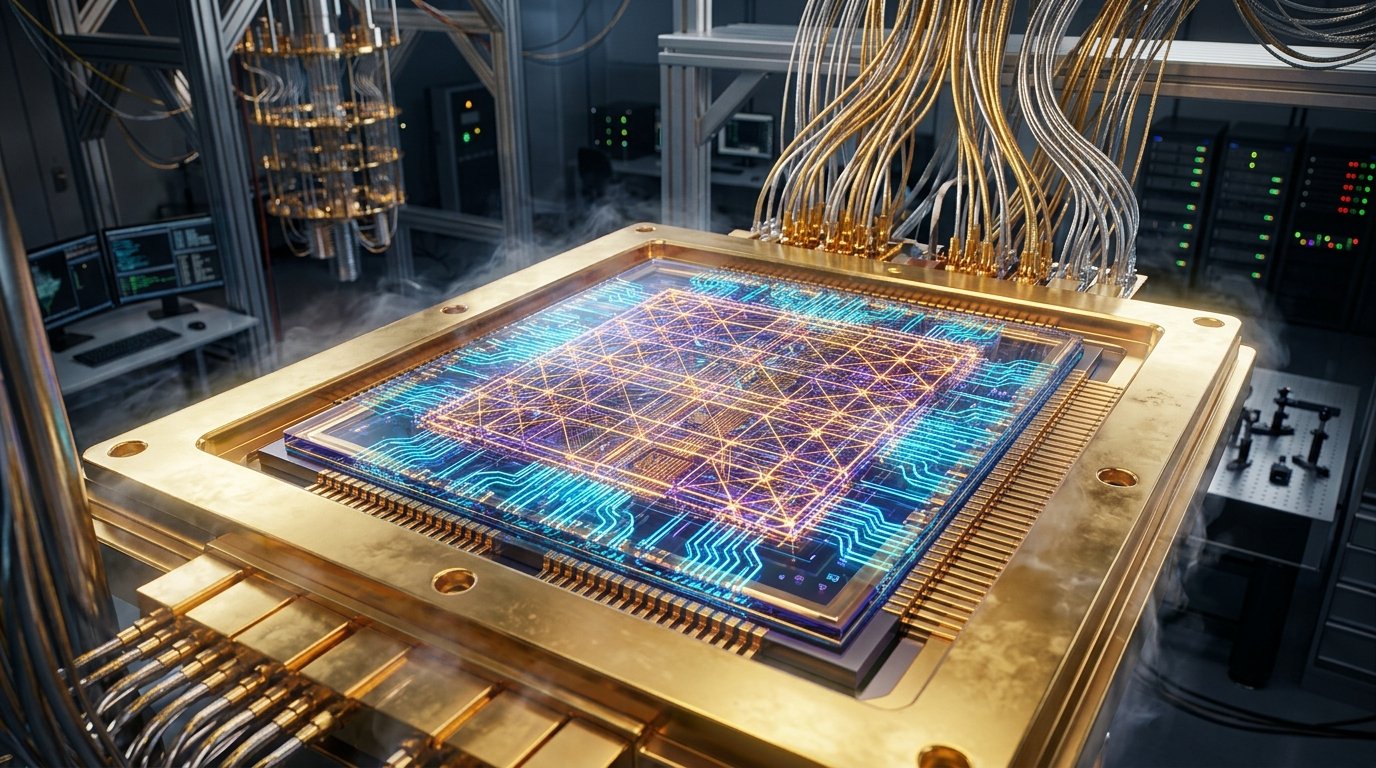
Transitioning from Noisy Intermediate-Scale to Fault-Tolerance
Quantum computing has officially entered the fault-tolerant era. Leading research laboratories have demonstrated that quantum error correction (QEC) can successfully suppress physical hardware noise, allowing logical qubits to execute calculations longer than the underlying physical components.
Quantum Error Correction Mechanics
The achievement relies on intricate surface codes and neutral-atom manipulation:
You May Also Like
- Topological Surface Codes: Entangling dozens of physical qubits into a single logical qubit, detecting phase and bit-flip errors via non-destructive syndrome measurements.
- Neutral-Atom Traps: Utilizing laser-controlled optical tweezers to position individual rubidium atoms dynamically, enabling reconfigurable multi-qubit gates.
- Algorithmic Fault-Tolerance: Demonstrating quantum circuits with hundreds of two-qubit operations operating below the fault-tolerance threshold limit.
Fault-tolerant quantum processors will soon simulate complex molecular catalysts, accelerating drug discovery and room-temperature superconductor development.
Post-Quantum Cryptography Urgency
The steady maturation of logical qubits reinforces the critical urgency for enterprise migration to NIST-standardized Post-Quantum Cryptography (PQC) algorithms such as ML-KEM and ML-DSA.


Comments (0)
Leave a Comment