
Tailoring Foundation Models to Enterprise Realities
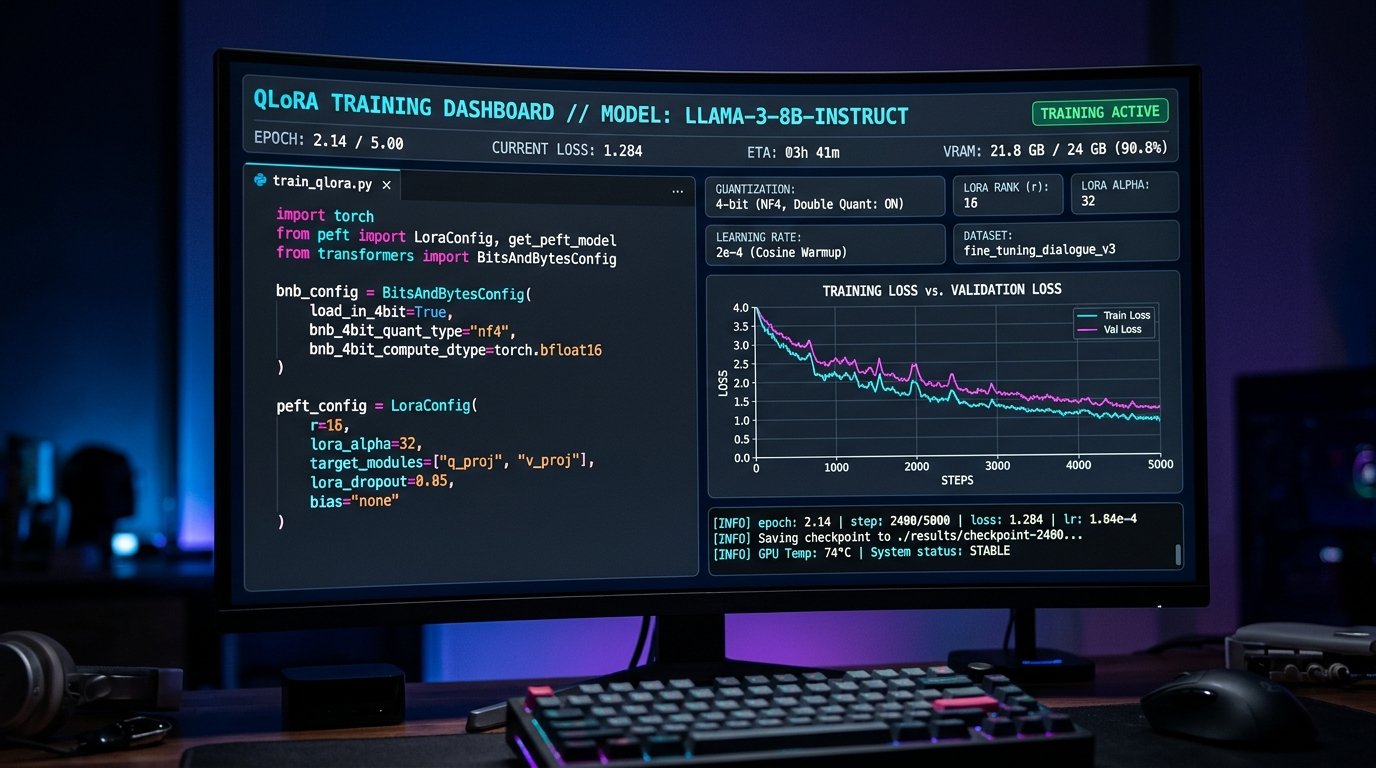
While retrieval-augmented generation (RAG) is ideal for factual lookup, domain-specific tone, specialized jargon, and strict syntax formatting necessitate parameter-efficient fine-tuning (PEFT) of open-source models like Llama and Mistral.
The QLoRA Engineering Workflow
Quantized Low-Rank Adaptation (QLoRA) makes fine-tuning accessible on consumer-grade hardware:
You May Also Like
- 4-Bit NormalFloat Quantization: Freezes the base model weights in 4-bit precision, reducing VRAM overhead while preserving mathematical accuracy.
- Trainable Adapter Matrices: Injects low-rank trainable weight adapters into self-attention layers, updating less than 1% of total parameters.
- Dataset Structuring and Curation: Constructing diverse instruction-tuning JSONL pairs formatted according to the model's native chat template.
- Loss Evaluation and Validation: Monitoring cross-entropy loss against a held-out test split to detect overfitting and catastrophic forgetting.
Fine-tuning directly embeds structural procedural compliance into model weights, drastically reducing prompt token overhead in high-volume API pipelines.
Model Merging and Quantized Deployment
Following training, adapter weights can be merged back into the base model and converted to GGUF or AWQ formats for ultra-fast production inference via vLLM.





Comments (0)
Leave a Comment