
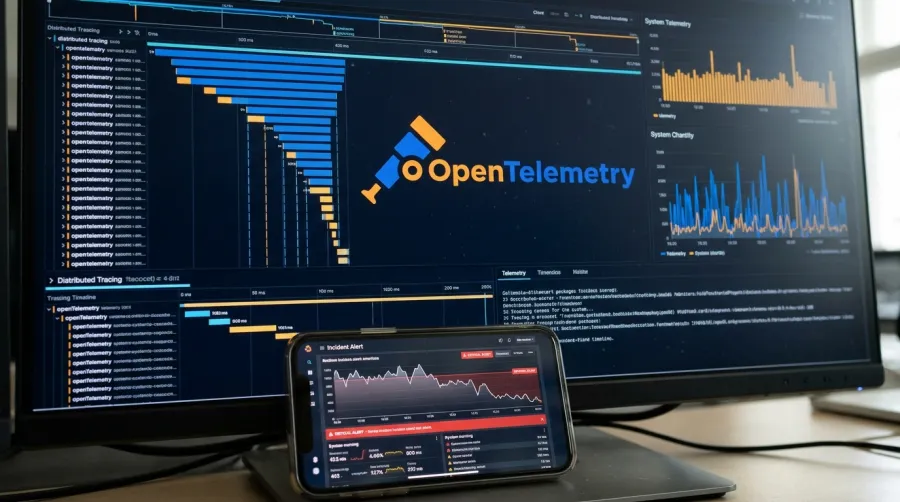
OpenTelemetry paired with AI-assisted observability cuts microservices Mean Time to Resolution (MTTR) by 40% to 60% in 2026 by replacing manual log grepping with automated causal root cause analysis. Standardizing traces, metrics, and logs through OpenTelemetry gives AI incident agents clean, vendor-neutral telemetry to diagnose cascading failures in under five minutes.
The 2026 Observability Paradox: Mountains of Data, Slow Diagnosis
Enterprise engineering teams are collecting more telemetry than ever, yet most still struggle to turn raw signals into fast incident resolution. According to LogicMonitor's 2026 Observability and AI Outlook, only 41% of IT leaders are satisfied with their platform's ability to extract actionable insights—leaving 59% sitting on telemetry mountains without automated diagnosis. Worse, 67% of IT leaders say their organization is likely to switch observability platforms within one to two years due to rising ingestion costs and poor signal-to-noise ratios.
At the same time, Dynatrace's State of Observability 2026 report reveals that 77% of organizations have moved OpenTelemetry beyond evaluation, with 20% making it a strategic enterprise standard. As microservices and serverless edge deployments—tracked regularly on EgyMonitor—grow more distributed, proprietary vendor agents can no longer keep pace.
How OTel Feeds AI Root Cause Analysis Engines
AI-assisted observability fails when telemetry schemas vary wildly across Go, Java, Python, and Node.js services. OpenTelemetry semantic conventions enforce a unified attribute vocabulary—such as http.request.method, db.system.name, and service.name—so downstream causal models can traverse dependency graphs without brittle per-service regex rules.
When OTel collectors stream normalized traces and logs into AI SRE platforms, the impact on MTTR is measurable. Enterprise benchmarks from IR show AI-driven observability reduces MTTR by 40% to 60%. In production case studies reported by Traversal, a Fortune 100 financial services deployment achieved 82% root cause accuracy in under five minutes while ingesting 250 billion logs daily, cutting potential MTTR by 32%, while PepsiCo reduced investigation time by 70% across 500,000+ monthly alerts.
OpenTelemetry GenAI Semantic Conventions: Tracking LLM and Agent Telemetry
As teams embed LLM calls and autonomous agents inside microservices—including edge architectures explored in EgyMonitor's serverless edge computing analysis—traditional HTTP spans miss token costs, prompt latency, and agent loops. In June 2026, v1.42.0 of the specification moved gen_ai.* attributes into a dedicated OpenTelemetry GenAI semantic conventions repository to support faster release cycles.
While Elastic's 2026 observability research notes that 85% of organizations already use some form of GenAI in observability and 89% of production OTel users prioritize full specification compliance, engineers must handle GenAI conventions carefully. Because the gen_ai.* namespace remains at Development status in late 2026 (having undergone three attribute renames in a single cycle), attribute names still evolve between releases.
You May Also Like
Comparing Traditional APM vs. OTel + AI Observability
The table below contrasts legacy siloed monitoring against modern distributed tracing and AI-assisted incident workflows.
| Capability | Legacy Proprietary APM | OpenTelemetry + AI Observability (2026) |
|---|---|---|
| Instrumentation | Vendor-locked language agents | Vendor-neutral OTel SDKs & Collectors |
| Root Cause Analysis | Manual dashboard correlation | Multi-hop causal AI (82%+ accuracy in <5 min) |
| AI / LLM Visibility | Ad-hoc custom logging | gen_ai.* semantic conventions (tokens, spans) |
| Alert Triage | Static threshold paging | Autonomous alert deduplication & context grouping |
| Platform Portability | High switching cost | Swap backends via Collector exporter config |
"87% of enterprises now use AI agents for observability and IT operations, yet humans still verify 66% of AI-powered decisions because only 27% of teams have full visibility into how agents reach conclusions."
Core Risks in AI-Assisted Observability Rollouts
- Schema Drift on Development Conventions: Building rigid billing or SLA dashboards directly on unstable
gen_ai.*attributes can break during minor specification upgrades. - Cardinality and Cost Explosions: Unfiltered span attributes and full prompt-completion capture can inflate observability ingestion bills by 3x to 5x if tail-sampling is omitted.
- Agent Governance Blind Spots: Allowing autonomous remediation agents to restart pods or roll back deployments without human-in-the-loop audit trails risks cascading outages.
- Tool Sprawl Overhead: Running overlapping commercial agents alongside OTLP pipelines drives 84% of enterprises to pursue tool consolidation in 2026.
5-Step Blueprint to Cut MTTR with OpenTelemetry
- Standardize on Stable Semantic Conventions: Enforce stable HTTP (v1.23+) and database (v1.33+) attributes across every microservice repository before onboarding AI triage.
- Deploy Tail-Based Sampling at the Collector: Retain 100% of error and high-latency traces while sampling healthy baseline traffic to control ingestion spend.
- Isolate GenAI Instrumentation Behind Abstractions: Wrap
gen_ai.*spans in an internal SDK adapter so future convention renames require one-line updates. - Feed Unified Traces to Causal AI Triage: Connect your OTLP pipeline to an AI incident engine that correlates recent deployments, logs, and dependency graphs.
- Gate Autonomous Remediation with Verification: Start AI agents in read-only diagnosis mode before granting supervised rollback or traffic-rerouting permissions.
SRE Checklist for Collector Resilience
Configure memory limiters and persistent disk queues on every Collector node so traffic spikes during an outage never drop critical root-cause spans, and use dual-emit migration modes (OTEL_SEMCONV_STABILITY_OPT_IN) when upgrading attribute versions.
Frequently Asked Questions
Does adopting OpenTelemetry lock us into a specific observability vendor?
No. The CNCF telemetry standard decouples instrumentation from storage and analysis, allowing teams to route identical OTLP streams to Datadog, New Relic, Dynatrace, Elastic, or ClickHouse simultaneously.
Are OpenTelemetry GenAI semantic conventions production-ready in late 2026?
They are widely supported by major vendors for tracing LLM latency and token usage, but remain in Development status, meaning attribute names can still change across updates.
How much does AI-assisted observability actually reduce MTTR?
Enterprise deployments in 2026 report 32% to 60% MTTR reductions overall, with automated root cause analysis cutting initial alert investigation time by up to 70%.
Why do teams pair tail-based sampling with AI incident engines?
Tail-based sampling evaluates complete traces before exporting, ensuring AI diagnostic models always receive 100% of anomalous error and latency traces without paying to store redundant healthy requests.




Comments (0)
Leave a Comment