
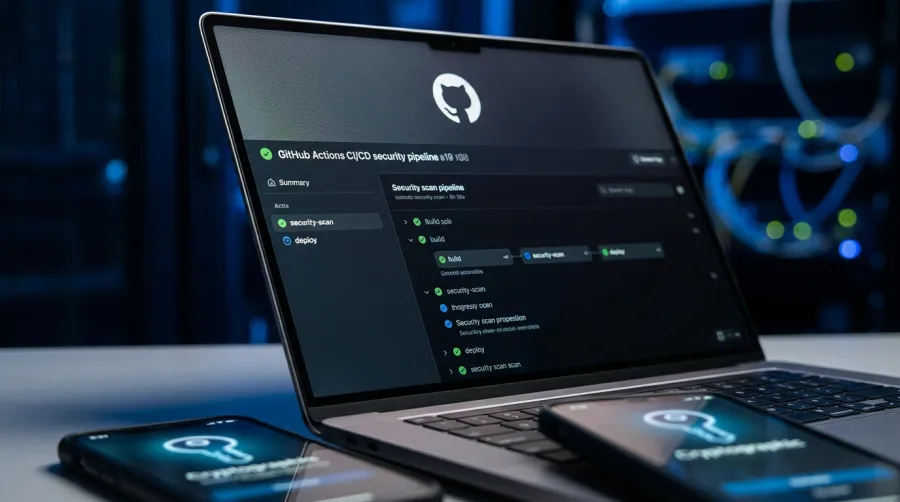
Automated CI/CD security in 2026 combines CycloneDX or SPDX Software Bills of Materials (SBOMs), keyless Sigstore artifact signing, and ephemeral runners to block software supply-chain attacks before code reaches production. With third-party compromises driving 48% of data breaches, cryptographic provenance and disposable build environments are now mandatory baseline controls.
Why Software Supply-Chain Attacks Surge in 2026
Attackers have shifted away from perimeter exploits toward poisoning the build pipeline itself. According to Sonatype telemetry compiled by ScanTitan, 1,960,846 malicious open-source packages were logged through Q3 2026—including 149,329 malicious packages in Q3 alone, 89.5% of which targeted npm. Meanwhile, Docker's 2026 Software Supply Chain Security Report found that 77% of surveyed organizations experienced a supply-chain incident in the past 12 months.
The financial stakes are severe: Verizon's 2026 DBIR recorded third-party involvement in 48% of breaches (a 60% jump year-over-year), while IBM puts the average supply-chain breach cost at $4.96 million with a 258-day lifecycle. As May 2026 GitHub Actions credential-theft attacks and recent runtime vulnerability waves like PHP2Shell demonstrate, weak pipeline controls turn every dependency update into an exposure vector.
SBOMs Under EU CRA and NIS2: CycloneDX 1.7 vs. SPDX 3.0
Generating a machine-readable SBOM on every build is no longer optional under European Cyber Resilience Act (CRA) and NIS2 compliance timelines. As outlined in InfraZen's 2026 DevSecOps playbook, teams standardize on either SPDX 3.0 (with security and build profiles) or CycloneDX 1.7 (building on the ECMA-424 standard). Storing signed SBOMs alongside container images lets security teams query affected workloads in seconds when a zero-day drops, rather than scanning thousands of running containers manually. Integrating CycloneDX VEX (Vulnerability Exploitability eXchange) documents alongside SBOMs further reduces alert noise by flagging whether a vulnerable transitive dependency is actually reachable in production.
Sigstore Keyless Signing and Artifact Attestations
Traditional PGP signing keys leak easily from CI variables. GitHub Actions Artifact Attestations solve this using Sigstore: the runner exchanges a short-lived OIDC token for an ephemeral signing certificate, writes a SLSA provenance bundle, and logs public-repo signatures in Sigstore's immutable transparency log (while private repositories use GitHub's isolated Sigstore instance).
Verification policies require strict hygiene, however. Following CVE-2026-64655 in GitHub CLI (where regex matching in --signer-repo could allow lookalike repositories prior to v2.97.0), admission controllers must pin exact numeric repository IDs rather than wildcard strings. Pairing Sigstore verification with Open Policy Agent (OPA) or Kyverno admission webhooks ensures unsigned or tampered images are rejected at the Kubernetes API boundary before scheduling.
Comparing Legacy CI/CD vs. Hardened 2026 CI/CD Security
The table below contrasts vulnerable legacy pipelines against automated CI/CD security controls.
You May Also Like
| Pipeline Layer | Legacy Vulnerable Pattern | Hardened 2026 CI/CD Security |
|---|---|---|
| Build Compute | Persistent self-hosted VMs with shared caches | Ephemeral single-use containers destroyed post-job |
| Cloud Credentials | Long-lived IAM keys in repo secrets | Short-lived OIDC federation & npm trusted publishing |
| Dependency Updates | Unpinned @v4 tags, instant auto-install |
Full 40-char SHA pinning + 3-day Dependabot cooldown |
| Artifact Trust | Unsigned tarballs and container tags | Sigstore OIDC attestations + SLSA v1 provenance |
| Inventory Visibility | Manual spreadsheet dependency audits | Automated CycloneDX 1.7 / SPDX 3.0 SBOM per build |
"Less than one in four organizations regularly audit their software supply chain, even as 57% expect more than half of their codebase to originate from third-party sources within 12 months."
High-Impact Threats Targeting Unhardened CI/CD Runners
- Cache Poisoning on Persistent Runners: Attackers abuse shared build caches across pull requests to inject backdoors into downstream release artifacts.
- Mutable Action Tag Hijacking: Referencing third-party GitHub Actions by branch or major tag (
@v3) instead of immutable commit SHAs lets compromised maintainers push malicious code silently. - Typosquatting and Instant Package Drops: With 74.5% of overtly malicious packages in Q3 2026 acting as droppers or secret stealers, pulling unvetted releases immediately compromises runner secrets.
- Over-Privileged Workflow Tokens: Default
GITHUB_TOKENwrite permissions allow compromised build steps to push tags or modify releases without approval.
5-Step Playbook to Automate CI/CD Security
- Enforce Ephemeral Runners Everywhere: Provision single-job microVMs or Kubernetes pods that wipe memory, disk, and network state immediately after completion.
- Eliminate Static Secrets with OIDC: Replace cloud API keys and npm tokens with OIDC workload identity and trusted publishing.
- Add Dependency Cooldowns and SHA Pinning: Pin all third-party actions to full commit SHAs and enforce a 72-hour cooldown on non-security package updates.
- Sign Binaries and SBOMs with Sigstore: Attach
actions/attest-build-provenanceandactions/attest-sbomto every release workflow. - Verify Attestations at Deployment Time: Gate Kubernetes admission controllers using exact repository IDs before any container image starts.
Egress Filtering Tip for Build Environments
Deploy runtime egress monitors like Harden-Runner in audit mode first to map legitimate package registry domains, then block unauthorized outbound connections from CI jobs. Additional security briefings are available on EgyMonitor.
Frequently Asked Questions
Why are ephemeral runners critical for CI/CD security?
Ephemeral runners spin up a clean environment for each job and destroy it immediately afterward, preventing lateral movement, credential harvesting, and persistent cache poisoning across builds.
How does Sigstore sign artifacts without long-lived private keys?
Sigstore binds a short-lived cryptographic key to an OIDC identity token issued by the CI provider, signs the artifact or SBOM, and records the timestamped certificate in a tamper-evident log.
Should teams generate SBOMs in SPDX or CycloneDX format?
Both are widely accepted by regulators and scanners; choose CycloneDX 1.7 for security-first vulnerability workflows or SPDX 3.0 when enterprise legal and licensing compliance teams require it.
How do dependency cooldowns stop malicious npm packages?
Waiting 72 hours before auto-merging non-security dependency updates gives registry security teams and automated scanners time to detect and yank newly published typosquatted or compromised packages before your CI/CD security gates ever pull them.





Comments (0)
Leave a Comment