
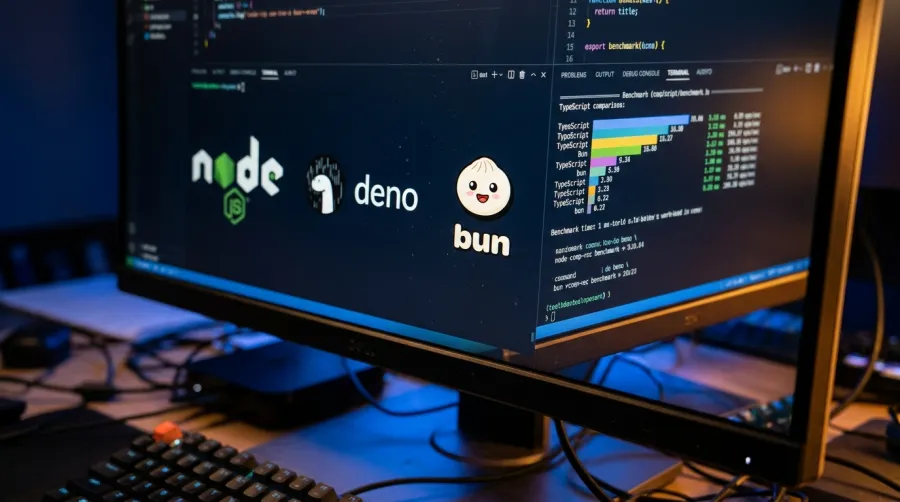
In late 2026, all three major JavaScript runtimes—Bun 1.4, Deno 2, and Node.js 24 LTS—execute TypeScript natively, but Bun leads raw HTTP throughput at roughly 1.84x Node.js 24's speed while Node.js retains the safest enterprise ecosystem. Choosing among these JavaScript runtimes comes down to cold-start budgets, TypeScript syntax constraints, and security sandboxing.
How JavaScript Runtimes Evolved Through 2026
The server-side ecosystem has shifted from winner-take-all hype to workload-specific specialization. Anthropic's acquisition of Bun for CLI tooling, Bun's August 2026 v1.4 Rust runtime rewrite, Deno 2's deep Node.js and npm compatibility (reaching Deno 2.8 with built-in audit and CI subcommands), and Node.js 24's LTS maturation mean developers can evaluate JavaScript runtimes on measured production telemetry rather than synthetic microbenchmarks.
For teams deploying across edge and container platforms—a landscape tracked in EgyMonitor's 2026 serverless edge computing comparison—the choice among modern JavaScript runtimes directly impacts AWS Lambda billing, container density, and CI build times.
Late 2026 Server Benchmarks: Throughput, Memory, and Cold Starts
Head-to-head October 2026 benchmarks comparing Bun 1.4.3 against Node.js 24 show Bun serving 1.84 times Node 24's requests per second on a Hono JSON API and 1.48 times Node's throughput when executing a Postgres query on every request. Under load, Bun consumed 36 MB RSS compared to 105 MB for Node.js—a 25% to 70% memory reduction that translates directly into higher pod density on Kubernetes. Notably, Bun 1.4's migration from Zig to Rust consolidated JavaScriptCore and runtime memory allocation on mimalloc, yielding 13% to 48% lower HTTP server memory and five times lower idle CPU in production rollouts.
In broader AWS Graviton 3 benchmarks (16 vCPUs, 32 GB RAM), Bun handled up to 245,000 req/s with Elysia, Deno 2 reached 180,000 req/s, and Node.js 24 with Fastify achieved 95,000 req/s. Cold starts show an even sharper gap: Bun launches an empty script in 3.3 ms versus 28.5 ms on Node 24, and executes a TypeScript file in 3.8 ms versus 62.6 ms on Node 24. On AWS Lambda, Bun averages 156 ms cold starts compared to 245 ms on Node.js—a 35% cost and latency edge.
Under the Hood: Node.js 24 LTS, Deno 2.8, and Bun 1.4 Milestones
Each runtime shipped substantial platform upgrades across 2025 and 2026. Node.js 24 LTS ("Krypton")—supported through April 30, 2028—pairs V8 13.6 (adding explicit resource management via await using, RegExp.escape, Float16Array, and WebAssembly Memory64) with Undici 7.0 for faster built-in fetch() and HTTP/2 connection pooling, global URLPattern, and npm 11. Meanwhile, Deno 2.8 boosted its pass rate on Node.js's own test suite from 42% to 76.4% (3,405 of 4,457 tests), removed the npm: CLI prefix requirement for deno install with 3.66x faster cold installs, and introduced six subcommands including deno audit fix, deno ci, and deno transpile alongside V8 14.9 and TypeScript 6.0.3.
Native TypeScript Execution: Strip-Types vs. Full Transpilation
While every modern platform among today's JavaScript runtimes runs .ts files directly, their underlying mechanics differ sharply. Node.js 24's stable type stripping uses a lightweight WebAssembly parser to remove erasable type annotations without reading tsconfig.json or transforming runtime-generating syntax like enums, namespaces, or legacy decorators.
You May Also Like
As engineering teams adopting Node.js native TypeScript have discovered, Node 24 encourages erasableSyntaxOnly and explicit ESM file extensions while still requiring tsc --noEmit in CI for type checking. Bun transpiles full TypeScript including enums natively, while Deno 2 supports full TypeScript plus deno check for built-in static type verification.
| Dimension | Bun 1.4 | Deno 2 (v2.8+) | Node.js 24 LTS |
|---|---|---|---|
| JS Engine | JavaScriptCore (Rust rewrite) | V8 14.9 (Rust) | V8 13.6 (C++) |
| HTTP Throughput (Graviton 3) | Up to 245,000 req/s | ~180,000 req/s | ~95,000 req/s |
| TS Cold Start (Local) | 3.8 ms | 34 – 60 ms | 62.6 ms (strip-types) |
| TypeScript Support | Full transpilation (no check) | Full + deno check (TS 6.0.3) |
Erasable syntax only |
| Security Model | Ambient access (like Node) | Explicit permission flags | Ambient (opt-in --permission) |
| Package Install Speed | 13x–29x faster than npm | 3.66x faster cold npm/JSR cache | npm v11 (baseline) |
"Pick Node.js when the cost of an ecosystem surprise is high, Deno 2 when strict sandboxing and built-in tooling matter, and Bun when iteration speed and serverless cold starts dominate."
Ecosystem Compatibility and Migration Realities
- Native Addon Coverage: Bun 1.4 added 1,517 passing Node.js tests and cleanly runs heavy native packages like
sharp,better-sqlite3,bcrypt,argon2, and Next.js 16.4 builds, achieving ~95% npm compatibility. - Package Manager Speedup: Even teams keeping Node.js in production increasingly adopt
bun installin CI, which runs 13x faster than npm cold and 29x faster with a warm cache. - Deno's Zero-Trust Edge: Deno 2 refuses ambient filesystem, environment, and network access unless explicitly granted, making it ideal for running untrusted plugins or AI-generated code.
- Node.js 26 LTS Horizon: With Node.js 26 entering LTS in October 2026 and delivering an 8% to 16% HTTP uplift over Node 24, conservative enterprises have a low-risk upgrade path without changing platforms.
4-Step Runtime Evaluation Guide for Engineering Teams
- Adopt Bun as Your Package Manager First: Cut CI dependency install times from minutes to seconds without altering production runtime behavior.
- Standardize on Erasable TypeScript: Enable
erasableSyntaxOnlyintsconfig.jsonso codebases remain portable across Node.js 24, Deno 2, and Bun. - Benchmark Real I/O Endpoints: Test your actual ORM, middleware, and serialization paths—not synthetic hello-world routes—before migrating services.
- Isolate Untrusted Execution in Deno 2: Use Deno's granular permission flags for webhook handlers, sandboxed scripts, and multi-tenant workers.
Production Memory Stability Note
When migrating long-running APIs from Node.js to Bun, run multi-day soak tests under realistic traffic to verify JavaScriptCore garbage-collection stability before full cutover. More cloud engineering deep dives are available on EgyMonitor.
Frequently Asked Questions
Does Node.js 24 eliminate the need for tsc or esbuild?
Not completely. Node.js 24's built-in type stripping removes type annotations at runtime but performs no type checking and rejects enums or decorators, so teams still run tsc --noEmit in CI.
Is Bun 1.4 ready for production backends in late 2026?
Yes for most HTTP APIs, serverless functions, and CLI tools, with ~95% npm compatibility including native modules like sharp and pg, though large legacy Node monoliths should still run multi-day memory soak tests.
When does Deno 2 beat both Bun and Node.js?
Deno 2 wins when security sandboxing, an integrated linter/formatter/type-checker toolchain, and Web-standard APIs matter more than squeezing out maximum raw HTTP requests per second.
Can teams mix JavaScript runtimes across a single monorepo?
Yes. Many organizations run Node.js 24 or 26 for legacy monoliths, use Bun for fast CI installs and serverless APIs, and deploy Deno 2 for isolated edge workers.







Comments (0)
Leave a Comment