
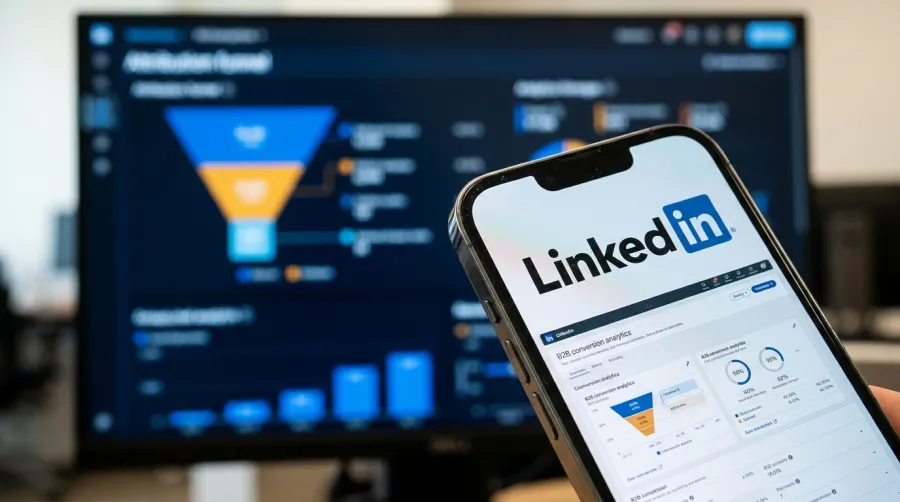
Programmatic B2B demand generation in 2026 connects first- and third-party intent signals to server-side ad optimization via LinkedIn's upgraded Conversions API (CAPI)—which now supports 180-day attribution windows, granular MQL/SQL event types, and SHA-256 hashed name and phone matching to track 6-to-18-month buying committees.
Why Server-Side Signals Now Dictate B2B Paid Performance
Roughly 90% of B2B display budgets now flow through programmatic platforms, targeting an average of 11 stakeholders per buying committee across 6-to-18-month sales cycles, according to Improvado's October 2026 analysis. Meanwhile, The Growth Syndicate's 2026 B2B benchmarks place the median B2B website conversion rate at just 2.9% (and visitor-to-lead at 2.3%), meaning browser cookies alone cannot bridge a seven-month gap between a prospect's first ad impression and a closed-won CRM deal—a measurement challenge we also examined in our 2026 server-side tracking and attribution guide.
That long lag is exactly why Dreamdata's 2026 LinkedIn Ads benchmark—spanning 66 million sessions and 3.5 million B2B customer journeys across a network exceeding 1.3 billion members and 70 million companies—found an average of 281 days from first LinkedIn ad impression to closed revenue. In that dataset, LinkedIn captured 41% of B2B ad budgets and delivered 121% attributed ROAS, outperforming Google Search (67%) and Meta (51%).
Inside LinkedIn's Late-2026 Conversions API Upgrades
Between August and November 2026, Microsoft and LinkedIn shipped three major Marketing API releases that directly address B2B attribution blind spots in programmatic B2B demand generation:
Granular MQL/SQL Events and 180-Day Windows
Starting in version 202608, LinkedIn's Conversions API added dedicated MARKETING_QUALIFIED_LEAD and SALES_QUALIFIED_LEAD conversion types. In September 2026 (version 202609), LinkedIn introduced a 180-day option for both post-click and view-through attribution windows alongside the existing 365-day tier—vital for enterprise SaaS teams whose deals qualify in Q2 after Q1 ad exposure, as Affect Group notes. LinkedIn's CAPI accepts up to 600 requests per minute, 500,000 requests per day, and batches of up to 5,000 events.
Privacy-Safe Hashed Name and Phone Matching
Version 202609 also added hashedFirstName and hashedLastName (64-character SHA-256 HEX strings) to the userInfo object, and November 2026's version 202611 introduced SHA256_PHONE (normalized E.164 digits without the leading plus sign) plus a required surface parameter (LAN or CTV) for publisher lists. Pairing those hashes with SHA256_EMAIL and LinkedIn's first-party click ID (li_fat_id, retained for 365 days per SaaS Hero) prevents "Low Match Rate" warnings when sales reps enter contacts manually.
You May Also Like
Cross-Channel Signal Feeding Beyond LinkedIn
Decoupling audience creation from media buying is another 2026 breakout tactic for programmatic B2B demand generation. As Growth Unhinged reported in November 2026, PLG and B2B advertisers increased Meta's share of budgets from 20% to 32% by August 2026 by feeding 50+ weekly activated-signup CAPI events into Meta's Andromeda algorithm—capturing B2B buyers at B2C CPMs.
"Extending the attribution window does not create an actual increase in leads or revenue; it changes the rules for attributing delayed CRM events to earlier ad interactions." — Affect Group 2026 LinkedIn CAPI Analysis
2026 B2B Paid & Programmatic Benchmarks
| Channel / Format | 2026 Conversion / Engagement Benchmark | Cost / ROAS Metric | Source |
|---|---|---|---|
| LinkedIn Document Ads | 14.7% Lead Gen Form CVR | Top-converting native format | Mean CEO 2026 Study |
| LinkedIn Thought Leader Ads | 13.1% Lead Gen Form CVR | $87 avg. CPL (vs. $214 Text Ads) | Mean CEO 2026 Study |
| LinkedIn Native Lead Gen vs. Landing Pages | 11.9%–13% vs. 3%–4% CVR | 28% vs. 65% form drop-off | Traxy / First Page Sage |
| LinkedIn Predictive Audiences AI | 3.41% lead-to-conversion (+24.5%) | 12,400 B2B campaigns analyzed | Mean CEO / LinkedIn |
| LinkedIn Attributed ROAS | 121% ROAS (281-day cycle) | 41% of observed B2B ad spend | Dreamdata 2026 |
Orchestrating Intent Signals With Account-Based Attribution
Modern B2B lead detection replaces isolated form fills with layered intent scoring—and aligns organic visibility (see our GEO and AI Overviews guide) with paid retargeting:
- First-Party Intent: Pricing-page dwell time, product activation milestones, and multi-stakeholder site visits captured server-side.
- Third-Party & Social Intent: Category keyword surges, competitor comparison research, and Thought Leader Ad engagement.
- Company Intelligence & DMA Reporting: LinkedIn's 202609 endpoint lets analysts filter account-level paid qualified leads by campaign group, objective type, and seniority over 90-day lookbacks, while Ads Reporting adds Nielsen DMA geographic pivots.
- Automated Rule Association: Teams can set CAPI conversion rules to
OBJECTIVE_BASEDauto-association—bypassing the 200-campaign cap onALL_CAMPAIGNS—as LinkedIn's ad business scales toward WARC's projected $9.7 billion in 2026 revenue.
5 Steps to Deploy LinkedIn CAPI Without Data Leaks
- Capture
li_fat_idon every landing page form submission and store it as a permanent CRM contact property. - Create separate LinkedIn conversion rules for
LEAD,MARKETING_QUALIFIED_LEAD, andSALES_QUALIFIED_LEADwith 180-day or 365-day windows. - Stream CRM stage changes within 90 days of occurrence (
conversionHappenedAtis rejected if older than 90 days at upload). - Pass a shared
eventIdbetween the Insight Tag and CAPI so LinkedIn deduplicates browser and server events cleanly. - Normalize names and E.164 phone numbers identically in one shared function before SHA-256 hashing to prevent silent match-rate drops.
Frequently Asked Questions
What happens if a B2B deal closes seven months after a LinkedIn ad click?
If your conversion rule uses a 180-day or 365-day window and your CRM streams the stage change within 90 days of the event happening, LinkedIn can attribute that conversion back to the original ad interaction.
Which LinkedIn ad formats deliver the lowest cost per lead in 2026?
Thought Leader Ads average $87 per lead with a 13.1% conversion rate, while Document Ads hit 14.7%—outperforming Text Ads ($214 CPL) by nearly 2.5x.
Can I send phone numbers to LinkedIn CAPI without exposing plain text?
Yes. As of LinkedIn Marketing API version 202611 (November 2026), the /conversionEvents endpoint accepts SHA256_PHONE normalized to digits-only E.164 format.




Comments (0)
Leave a Comment