
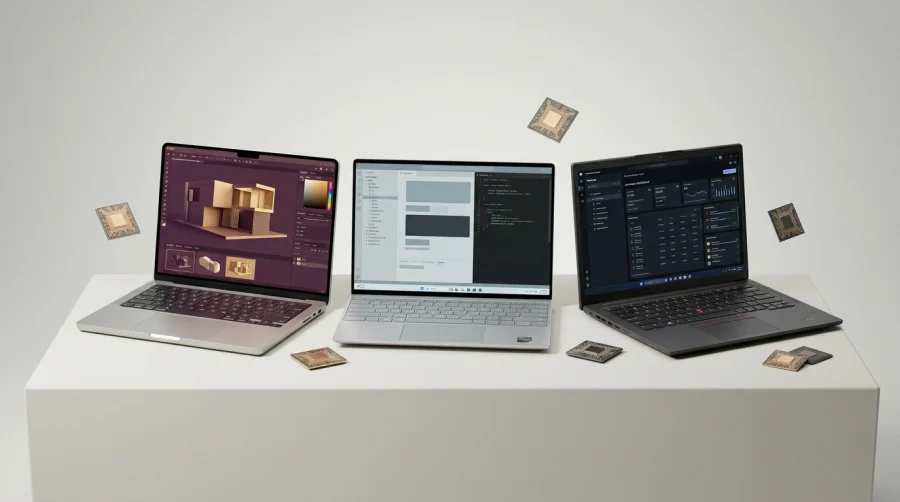
The best ultrabooks and AI PCs in late 2026 are led by Apple's 14-inch MacBook Pro with M6 for portable coding, the 16-inch M5 Pro for heavy creative rendering, and Intel Panther Lake machines like the Dell XPS 14 and Lenovo ThinkPad X9 15p for Windows engineers. Memory bandwidth and sustained thermals now outweigh headline NPU TOPS ratings.
Why Late 2026 Changed How Engineers Evaluate AI PCs
Two years ago, laptop vendors marketed neural processing units as a checkbox spec. By November 2026, real developer and creator workflows have exposed a sharper architectural divide. Lab testing from StorageReview and BestLaptop.deals shows that running local coding assistants, quantized 13B-to-70B language models, Docker stacks, and 4K timeline exports splits modern AI PCs into three distinct hardware classes: unified-memory workstations, NPU-first thin-and-lights, and discrete-GPU creator hybrids.
Software compatibility also matured rapidly. Windows on Arm via Qualcomm's Snapdragon X2 family now runs mainstream browsers, VS Code, and containerized workflows smoothly, while Intel's Panther Lake (Core Ultra Series 3) and AMD's Ryzen AI XDNA 2 platforms preserve native x86 compatibility alongside 40-plus TOPS Copilot+ certification.
Apple Silicon: MacBook Pro M6 vs. M5 Pro and M5 Air
Apple's late-2026 lineup gives developers enviable clarity. Introduced on October 27, 2026, the 14-inch MacBook Pro with M6 pairs a 12-core CPU and 12-core GPU with a 120Hz Liquid Retina XDR panel (1,000 nits SDR, 1,600 nits HDR), scoring 4,026 single-core and 21,964 multi-core in Geekbench 7 while weighing 3.4 pounds. For heavier compilation and multi-stream color grading, the 16-inch MacBook Pro with M5 Pro steps up to an 18-core CPU, 20-core GPU with integrated Neural Accelerators, three Thunderbolt 5 ports, Wi-Fi 7, and a massive 34,492 Geekbench 7 multi-core score.
The M5 MacBook Air Value Sweet Spot
Engineers working primarily on cloud sandboxes or web stacks rarely need active fans. Apple finally bumped the 2026 M5 MacBook Air base storage to 512GB alongside 16GB RAM, delivering 17 hours and 40 minutes to 18 hours of tested battery life in a silent aluminum chassis frequently discounted to $1,099.
Windows Flagships: Panther Lake and Snapdragon X2
On the Windows side, Intel's Panther Lake silicon powers two standout machines. The Dell XPS 14 (2026) pairs Copilot+ NPU acceleration with a punchy Tandem OLED screen built for designers, while the Lenovo ThinkPad X9 15p offers the closest Windows match to MacBook Pro build quality and sustained compile cooling. Prefer multi-day flight endurance? Microsoft's Surface Laptop 8th Edition with Snapdragon X2 Plus or X2 Elite delivers up to 20 to 23 hours of video playback with a crisp PixelSense touchscreen.
Linux-First Modularity and Local LLM Throughput
Open-source developers who refuse soldered RAM should look directly at the Framework Laptop 16 equipped with AMD's Ryzen AI 9 HX 370 (50 TOPS XDNA 2 NPU). Configured with 64GB of user-upgradeable memory, it sustains roughly 38 tokens per second on quantized 13B models while remaining fully repairable.
You May Also Like
Laptop Model (Late 2026)Processor / AI EngineMemory & DisplayTested / Rated BatteryIdeal WorkflowMacBook Pro 14 (M6)Apple M6 (12C CPU / 12C GPU)16GB–32GB / 14.2" 120Hz XDRUp to 24 hrs ratedFull-stack dev & portable AIMacBook Pro 16 (M5 Pro)M5 Pro (18C CPU / 20C GPU)24GB+ / 16.3" 120Hz XDRUp to 24 hrs rated4K/8K video & heavy buildsDell XPS 14 (2026)Intel Panther Lake (40+ TOPS)16GB–64GB / 14.5" Tandem OLED15–17 hrs mixed useWindows UI/UX & creatorsThinkPad X9 15p AuraIntel Panther Lake (Core Ultra)32GB / 15.3" High-Res OLED16+ hrs productivityEnterprise Windows codingSurface Laptop 8th Ed.Snapdragon X2 Elite (40+ TOPS)16GB–32GB / 13.8" or 15" Touch20–23 hrs playbackTravel & cloud-first devFramework Laptop 16Ryzen AI 9 HX 370 (50 TOPS)Up to 64GB+ / 16" 165Hz IPS~10 hrs workdayLinux dev & modular upgrades
"Discrete NVIDIA RTX PRO GPUs deliver the fastest tokens per second, but the model has to fit inside VRAM. Unified and shared memory designs trade raw speed for capacity so far larger models load at all." — StorageReview Local AI Laptop Leaderboard (November 2026)
What Actually Matters When Buying AI PCs for Production Work
Marketing badges alone cannot tell you whether a thin chassis will throttle five minutes into a Rust compile or Premiere export. Across our late-2026 evaluation of ultrabooks and AI PCs, four hardware fundamentals separate dependable tools from frustrating compromises.
- 32GB RAM as the new developer floor: Running an IDE, browser, Docker daemon, and a local 7B–14B coding model simultaneously saturates 16GB systems almost immediately.
- Unified memory bandwidth over raw NPU TOPS: While 40–50 TOPS NPUs handle background transcription, Recall, and Studio Effects efficiently—even hitting 37 tokens per second on compact Llama 3.2 3B models—larger LLMs rely on GPU memory bandwidth.
- Port selection without dongle clutter: Thunderbolt 5 on M5 Pro/Max and dual USB4 plus HDMI 2.1 on Panther Lake ultrabooks eliminate dock bottlenecks for dual-4K desk setups.
- Anti-reflective display coatings: Optional nano-texture glass on MacBook Pro and low-glare Tandem OLED panels dramatically reduce eye strain during ten-hour sessions.
Step-by-Step Spec Selection for Your Workload
- Audit your OS and toolchain constraints first—if you rely on CUDA libraries or Windows-only enterprise SDKs, filter immediately for Panther Lake or RTX-equipped Windows workstations.
- Lock in RAM capacity before upgrading CPU tiers; moving from 16GB to 32GB or 48GB yields bigger daily gains than stepping up two CPU cores.
- Verify external display bandwidth (Thunderbolt 4/5 or USB4) and SDXC card reader availability if you shoot RAW photography or ProRes footage.
- Compare sustained acoustic noise curves rather than peak burst benchmarks so fans stay quiet during client calls and deep focus blocks.
Frequently Asked Questions
Are Copilot+ AI PCs worth upgrading to in late 2026?
Yes—primarily for their massive leaps in battery efficiency, standby wake speed, and integrated graphics rather than Windows AI gimmicks alone. Modern Panther Lake and Snapdragon X2 laptops routinely double the battery life of 2023 x86 ultrabooks.
Should developers buy the M6 MacBook Pro 14 or the M5 Pro 16?
Choose the 14-inch M6 if single-core responsiveness, travel weight, and value matter most. Step up to the 16-inch M5 Pro if you compile massive monorepos, edit 4K/8K timelines, or need Thunderbolt 5 and higher multi-core throughput.
Can thin ultrabooks run local LLMs without an external GPU?
Yes. Unified-memory Macs with 32GB to 64GB RAM and 32GB-plus AMD Ryzen AI or Intel Lunar/Panther Lake AI PCs comfortably run quantized 7B to 32B models locally via Ollama or LM Studio for private code completion.


Comments (0)
Leave a Comment