
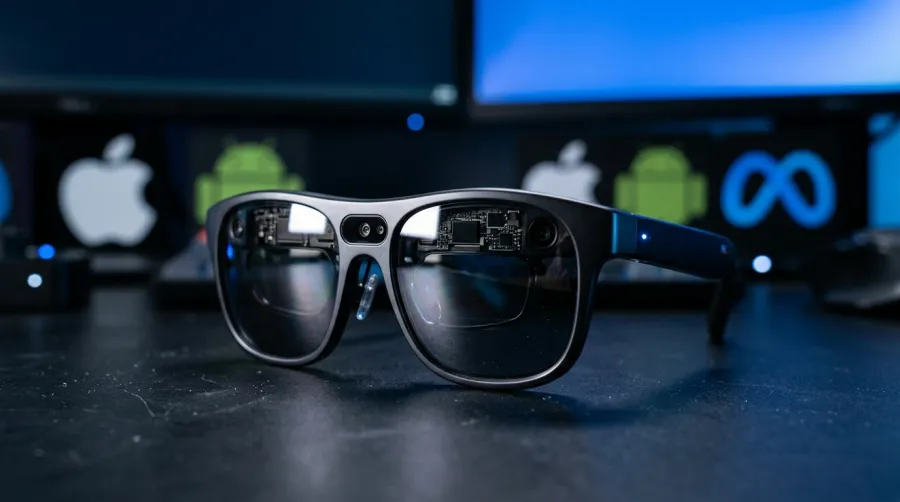
In 2026, spatial computing operating systems fractured along sharply different lines: Apple's visionOS 26 cemented high-precision enterprise workflows, Google's Android XR expanded from Samsung's Galaxy XR headset into $395 AI smart glasses, and Meta paused its third-party Horizon OS program to pivot toward first-party wearables.
Meta's Horizon OS Pivot Changes the Ecosystem Map
Two years after promising to become the Windows of virtual reality by licensing Horizon OS to Asus, Lenovo, and Xbox, Meta abruptly reversed course in December 2025. Confirming the freeze to industry outlets, Meta paused its third-party Horizon OS headset initiative—effectively canceling planned Asus ROG performance gaming and Lenovo productivity headsets—to concentrate Reality Labs engineering on first-party hardware.
The strategic retrenchment reflects broader capital reallocation inside Reality Labs. Reports in early 2026 indicated Meta explored cutting up to 30% of metaverse-focused spending, delaying its lightweight "Phoenix" mixed-reality glasses with a tethered compute puck from late 2026 into the first half of 2027 while beginning work on a gaming-centric Quest 4 and doubling down on AI eyewear—a shift explored further in EgyMonitor's 2026 smart glasses and AR wearables roadmap.
Android XR Captures the Multi-Vendor Mantle
Meta's withdrawal left Google's Android XR as the sole open-licensing platform for third-party hardware makers building spatial computing devices. Anchored by the Samsung Galaxy XR (formerly Project Moohan), which paired a Qualcomm Snapdragon XR2+ Gen 2 chip, dual micro-OLED panels, automatic interpupillary distance adjustment, and Gemini AI integration, Google spent 2026 extending Android XR across three distinct form factors: standalone headsets, tethered display glasses, and lightweight AI eyewear.
From Xreal Project Aura to Gentle Monster Glasses
On November 12, 2026, Samsung and Google opened pre-orders for Android XR Intelligent Eyewear designed in collaboration with luxury eyewear brands Gentle Monster and Warby Parker. Starting at $395 in multiple frame styles and shipping December 10, 2026, the smart glasses support both Android smartphones and iPhones out of the box while pairing with Google's Gemini assistant for hands-free navigation, live translation, and contextual visual queries. Meanwhile, Google confirmed that Xreal's tethered Project Aura—featuring a 70-degree field of view and pocket compute puck—remains on track as the next major Android XR hardware milestone alongside ongoing hardware collaborations with Sony for enterprise and industrial visualization headsets.
Apple visionOS 26: Precision Accessories and Mac Synergy
While Google chased form-factor breadth, Apple used 2026 to eliminate friction inside professional spatial computing workflows. Through visionOS 26.1 and 26.2, Apple added persistent spatial widgets that anchor to room geometry, spatial browsing in Safari, same-room collaboration Personas, native wide-field-of-view action-camera playback, and Travel Mode support inside cars and buses, plus enhanced spatial audio and hand-drawn input support for external styluses.
You May Also Like
90 Hz Spatial Accessories and Live USD Previews
At WWDC26, Apple opened the hardware peripheral layer with native 90 Hz six-degrees-of-freedom tracking for third-party spatial accessories, allowing industrial styluses and motion controllers to operate reliably even in low-light rooms combining infrared LEDs, IMUs, and haptics—including Sony PlayStation VR2 Sense controllers and reference dev kits from DFRobot and MikroE. For industrial designers and 3D studios, the new macOS Spatial Preview framework connects Mac applications directly to visionOS Quick Look for live USD scene editing, lighting overrides, and annotations over SharePlay, complemented by deeper Siri AI and Apple Intelligence integration previewed for visionOS 27 and direct CompositorServices support across Unity, Unreal, and Godot.
2026 Spatial Computing Operating System Comparison
| Operating System | Primary Hardware Partners | 2026 Form Factors | Core AI & Input Stack | 2026 Strategic Direction |
|---|---|---|---|---|
| Apple visionOS 26 | Apple Vision Pro (1st-party only) | Standalone spatial computer | Eye/hand tracking, 90 Hz spatial accessories, Siri AI | Enterprise 3D/Mac integration & controller support |
| Google Android XR | Samsung, Xreal, Gentle Monster, Warby Parker, Sony | MR headsets, tethered glasses, $395 AI glasses | Gemini multimodal AI, hands, eyes, voice | Open multi-OEM ecosystem across eyewear tiers |
| Meta Horizon OS | Meta Quest (3rd-party OEMs paused) | Standalone VR/MR headsets | Touch Plus controllers, hand tracking, Meta AI | First-party Quest 4 & AI glasses focus; Phoenix delayed |
"With Meta's Horizon OS now unavailable for third-party hardware, it seems we can expect any future entrants to the standalone headset market to use Google's Android XR instead." — UploadVR Analysis
What Defines Winning XR Software in Late 2026
Across enterprise and consumer deployments, four software capabilities now separate viable spatial computing platforms from stalled experiments:
- Cross-device continuity: Seamless handoff between smartphones, laptops, and lightweight eyewear without forcing users to re-buy app libraries or rebuild accounts.
- Low-latency multimodal AI: Always-available voice and visual context models (Gemini and Apple Intelligence) that justify wearing face-mounted sensors throughout the workday.
- Standardized 3D pipelines: Native support for OpenXR, USD, Unity, Unreal, and Godot via CompositorServices APIs that cut multi-platform porting costs.
- Ergonomic input flexibility: Combining gaze-and-pinch interfaces with physical 6DoF controllers for precision CAD modeling, surgical training, and gaming.
Product teams building spatial computing applications for 2027—alongside broader platform coverage on EgyMonitor—should prioritize three engineering steps:
- Target OpenXR and WebXR standards first to preserve portability between Android XR and Horizon OS.
- Separate heavy 3D spatial canvases (visionOS and Galaxy XR) from glanceable audio-visual AI prompts designed for $395 smart glasses.
- Benchmark Mac Spatial Preview and cloud-rendering streams before committing to native standalone binary ports.
Frequently Asked Questions
Why did Meta pause third-party Horizon OS headsets in 2026?
Meta paused its third-party Horizon OS program in December 2025—canceling planned Asus and Lenovo headsets—to refocus Reality Labs on first-party Quest hardware and shift investment toward AI smart glasses.
What is the cheapest way to try Google Android XR in late 2026?
Consumers can pre-order Samsung's Android XR Intelligent Eyewear, made with Gentle Monster and Warby Parker, starting at $395 ahead of December 10, 2026 shipping.
Does Apple visionOS 26 support physical gaming controllers?
Yes. visionOS 26 adds native 90 Hz tracking for spatial accessories, including Sony PlayStation VR2 Sense controllers and third-party haptic styluses.




Comments (0)
Leave a Comment