
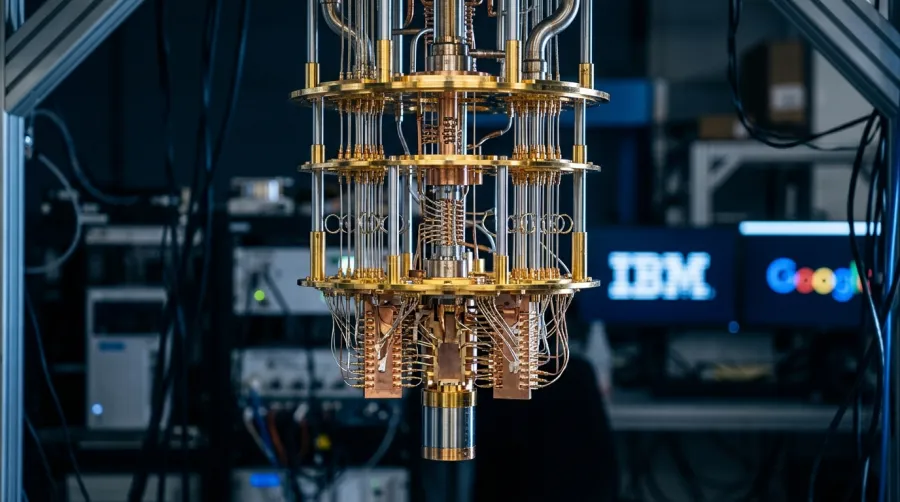
In 2026, quantum error correction crossed from laboratory theory into multi-platform engineering, led by IBM's modular Kookaburra processor, Google's Willow chip achieving 99.99% logical state fidelity via magic-state cultivation, and Microsoft's logical qubit partnerships with Quantinuum and Atom Computing.
Why 2026 Changed the Fault-Tolerance Equation
For decades, raw physical qubit counts served as the headline metric for quantum hardware, even though noisy superconducting circuits and fragile atomic traps lost coherence after a few hundred operations. That framing collapsed once engineering teams proved that adding physical qubits only helps when stabilizer codes suppress logical errors faster than hardware noise accumulates. According to Riverlane's industry tracking, peer-reviewed papers on error-correcting codes jumped from 36 in 2024 to 120 in the first ten months of 2025 alone, setting up 2026 as the year hardware vendors aligned chip topology directly around fault-tolerant architectures.
The strategic shift carries immediate consequences for enterprise cryptography planners. With U.S. federal agencies targeting a 2030 post-quantum migration, security teams following EgyMonitor's post-quantum cryptography enterprise roadmap now track logical-qubit fidelity and error-free quantum operations (QuOps) rather than raw physical qubit totals.
IBM's Modular qLDPC Strategy: Nighthawk and Kookaburra
Rather than scaling monolithic surface-code grids that demand roughly 1,000 physical qubits per logical qubit, IBM bet its architecture on quantum low-density parity-check (qLDPC) codes. On its 2026 Quantum Roadmap, IBM paired its 120-qubit Nighthawk processor—engineered to run 7,500-gate circuits across up to three linked modules—with the Kookaburra modular system, which spans roughly 4,158 physical qubits across a connected cluster.
Breaking the Monolithic Chip Bottleneck
IBM's qLDPC Starling architecture reduces physical qubit overhead by approximately 10x—up to 90%—compared with standard surface codes at equivalent logical error rates. Kookaburra combines a logical processing unit with quantum memory on a single module, while 2027's Cockatoo processor will entangle two Kookaburra modules via L-couplers on the path toward IBM Quantum Starling, a 200-logical-qubit machine slated for 2029 capable of 100 million gates.
Google Willow: Surface Codes and Magic-State Cultivation
Google Quantum AI approached logical qubit scaling from the opposite direction: perfecting two-dimensional surface codes and slashing the overhead of non-Clifford operations. After its 105-qubit Willow processor demonstrated below-threshold error suppression in late 2024, Google scaled from a 3x3 lattice to a 7x7 surface code in early 2026, cutting logical error rates roughly in half with each step in code distance.
October 2026 Magic-State Breakthrough
In October 2026, Google researchers published a landmark study in Science demonstrating magic-state cultivation on Willow. By refining how high-fidelity magic states are prepared without massive distillation factories, the team achieved an approximate 40-fold error reduction and a logical state fidelity near 99.99%. Recognizing hardware diversity, Google Quantum AI also added neutral-atom hardware as a second modality in March 2026.
You May Also Like
Microsoft's Virtualization Layer Across Trapped Ions and Neutral Atoms
Microsoft prioritized hardware-agnostic quantum error correction software through its qubit-virtualization system. Working with Quantinuum's H2 trapped-ion hardware, Microsoft demonstrated 12 logical qubits in March 2026 at a logical error rate near 2 in 1,000, followed by peer-reviewed results in Nature in June 2026. Simultaneously, Microsoft's neutral-atom collaboration with Atom Computing produced 24 verified logical qubits, while Quantinuum's Helios system pushed trapped-ion encoding to 48–50 logical qubits and QuEra reached 96 logical qubits using high-rate codes.
Comparing 2026 Fault-Tolerant Quantum Architectures
| Platform | Primary Modality | QEC Code Approach | 2026 Verified Milestone | Target Fault-Tolerant Scale |
|---|---|---|---|---|
| IBM Kookaburra & Nighthawk | Superconducting transmon | qLDPC modular memory + logic | ~4,158 physical qubits clustered; 7,500-gate circuits | 200 logical qubits (Starling, 2029) |
| Google Willow | Superconducting transmon | Surface code + magic-state cultivation | 7x7 surface code; ~99.99% cultivated logical fidelity | 1,000,000 physical qubits roadmap |
| Microsoft + Quantinuum / Atom | Trapped-ion & neutral atom | Qubit virtualization & 4D codes | 12 trapped-ion & 24 neutral-atom logical qubits | Utility-scale Azure Quantum systems |
| QuEra | Neutral atom | High-rate [[16,6,4]] LDPC code | Up to 96 encoded logical qubits | 100+ logical qubit applications |
"The 2025–2026 wave... was the period when quantum error correction crossed from theoretical certainty to working hardware on every major platform." — Quantum Zeitgeist 2026 Analysis
Core Engineering Metrics Defining Logical Qubit Progress
Evaluating fault-tolerant hardware claims requires looking past marketing headlines to four measurable physical benchmarks:
- Below-threshold scaling: Expanding code distance must strictly lower the logical error rate rather than compounding physical gate noise.
- Real-time syndrome decoding: Classical FPGA or ASIC decoders must interpret stabilizer measurements faster than qubits decohere during mid-circuit operations.
- Encoding overhead ratio: Lower physical-to-logical ratios, such as qLDPC or trapped-ion 2:1 schemes, determine how many logical qubits fit inside one cryostat or vacuum chamber.
- Logical gate depth (QuOps): Fault-tolerant algorithms require millions of sequential logical operations, not just idle memory preservation.
For enterprise CTOs tracking hardware readiness alongside broader industry shifts covered on EgyMonitor, adopting logical-qubit benchmarks follows a clear sequence:
- Audit cryptographic dependencies against NIST post-quantum standards before logical qubit counts reach RSA-breaking thresholds.
- Track real-time decoder latency and QuOps rather than raw physical qubit announcements.
- Test hybrid quantum-classical workflows on modular superconducting and trapped-ion cloud backends.
Frequently Asked Questions
What is the difference between physical and logical qubits?
A physical qubit is a single noisy hardware element such as a transmon or trapped ion, whereas a logical qubit encodes protected quantum information across many physical qubits using fault-tolerant stabilizer codes to suppress errors exponentially.
Did Google Willow or IBM achieve full fault-tolerant quantum computing in 2026?
Neither vendor reached full million-gate fault tolerance in 2026. Google proved below-threshold 7x7 surface-code scaling and 99.99% magic-state cultivation on Willow, while IBM deployed its modular Kookaburra architecture ahead of Starling's 200-logical-qubit target in 2029.
Why do qLDPC codes matter for quantum error correction?
Quantum LDPC codes connect qubits non-locally to encode more logical information with up to 90% fewer physical qubits than traditional 2D surface codes, dramatically lowering hardware size and cryogenic cost.

Comments (0)
Leave a Comment