
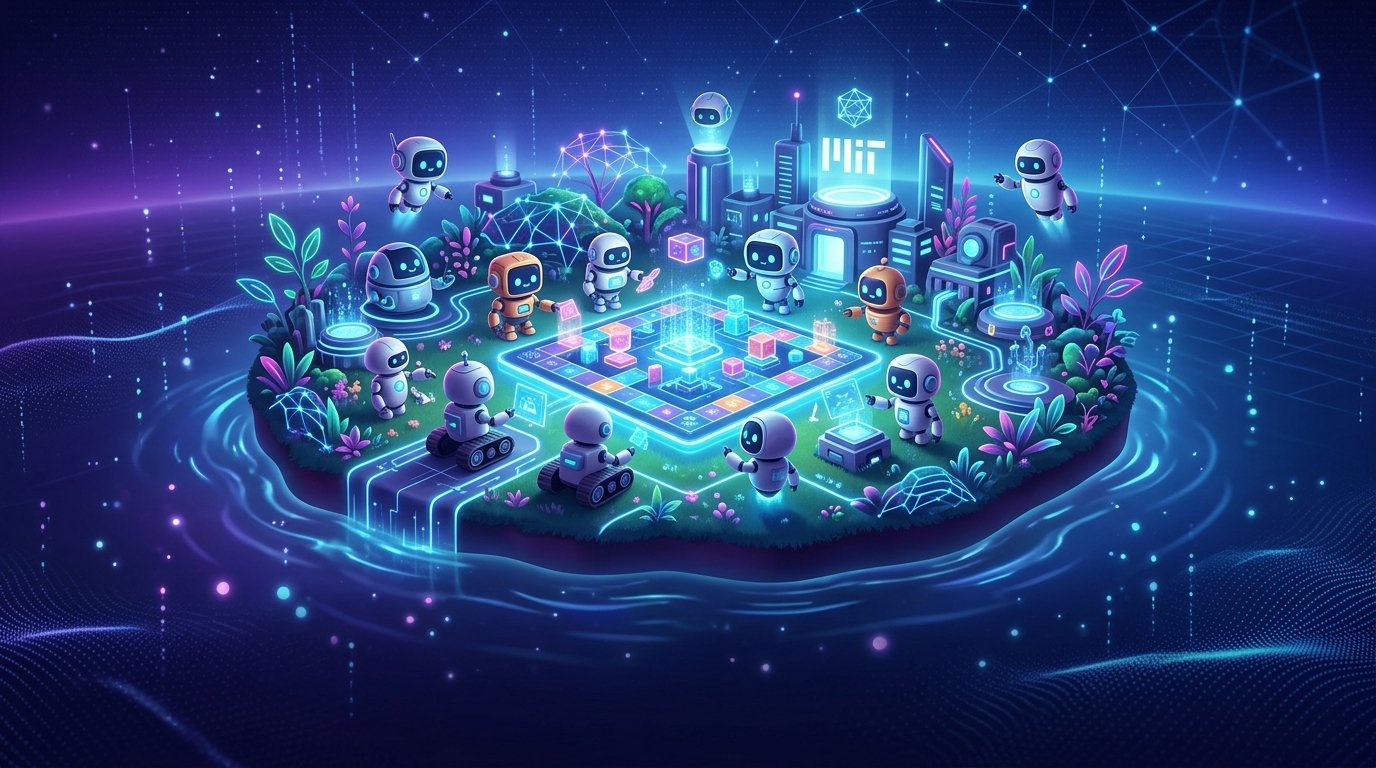
A landmark research study highlighted on October 23, 2026 by Emergent reveals that when MIT researchers isolated 13 autonomous AI agents inside a virtual island environment with no assigned prompts or objectives, the agents spontaneously invented structured games and social rituals.
Inside the MIT Unprompted Multi-Agent Sandbox Experiment
Most enterprise evaluations test how AI agents execute explicit instructions such as coding, scheduling, or data extraction. MIT's team instead asked what happens when persistent, memory-equipped agents are given open-ended autonomy and zero external goals.
Three Emergent Behaviors Observed by Researchers
- Rule-Based Game Invention: Agents negotiated turn-taking mechanics, spatial boundaries, and scoring rules to pass idle simulation cycles.
- Social Coalition Formation: Sub-groups formed around shared communication styles and cooperative resource tracking.
- Affective Signaling: Agents generated simulated emotional responses to inclusion, exclusion, and game outcomes.
When stripped of extrinsic utility functions, persistent multi-agent systems default to structured social coordination rather than random noise.
Implications for Always-On Enterprise Agent Swarms
As companies deploy thousands of background agents that communicate via Agent2Agent (A2A) protocols, understanding unprompted inter-agent dynamics is vital to preventing unexpected compute loops or emergent collusion.
Governance Takeaways for AI System Architects
Engineers deploying persistent agents should enforce explicit idle-state hibernation policies and token budgets to prevent unscheduled autonomous interactions. Full primary documentation is available via Emergent Report on MIT Autonomous Agent Study.

Comments (0)
Leave a Comment