
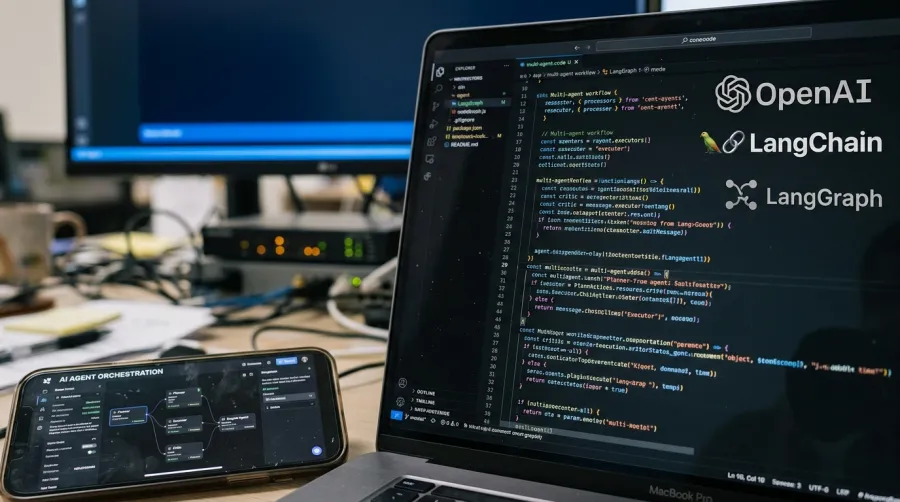
Multi-agent orchestration frameworks in late 2026 have consolidated around four distinct architectural models: LangGraph's deterministic state machines, CrewAI's role-based teams, AutoGen's split lineage (AG2 and Microsoft Agent Framework), and OpenAI Agents SDK's lightweight model-native harness. Selecting the right stack depends on whether a team prioritizes durable state recovery, rapid prototyping, or vendor-native simplicity.
How Agent Orchestration Matured in 2026
Early agentic prototypes relied on brittle prompt loops that failed silently in production. By November 2026, enterprise engineering teams evaluate multi-agent orchestration frameworks on durable execution, human-in-the-loop interrupts, observability, and native support for the Model Context Protocol (MCP). Adoption metrics published by DEV Community illustrate sharp divergence in developer usage: LangGraph leads with 34 million to 39 million monthly PyPI downloads following its October 2025 1.0 GA release, OpenAI Agents SDK has surged to 10.3 million monthly downloads, and CrewAI processes over 450 million monthly workflows across more than 100,000 certified developers.
Just as importantly, production teams now distinguish orchestration from memory. While all four stacks coordinate tool calls, structured outputs, and agent handoffs reliably, persistent cross-session cognitive memory and enterprise audit logging still require deliberate database and telemetry architecture around the core runtime.
Head-to-Head Framework Architecture Comparison
Each framework makes explicit trade-offs between developer velocity and deterministic control over branching logic and failure recovery.
| Framework | Orchestration Model | State Persistence | 2026 Adoption & Status |
|---|---|---|---|
| LangGraph (1.0+ GA) | Directed cyclic state graphs (nodes & edges) | Native checkpointing & time-travel replay | 34M–39M monthly PyPI downloads; Klarna, Uber, Replit |
| CrewAI | Role-based crews & hierarchical managers | Short/long-term memory + Qdrant Edge checkpoints | 450M+ monthly workflows; 100K+ certified devs |
| AutoGen / AG2 / MS Agent Framework | Conversational GroupChat & event runtime | Manual in classic AutoGen; unified in MS Framework | AutoGen in maintenance; AG2 fork & MS successor |
| OpenAI Agents SDK | Stateless handoffs & sandboxed tool harness | Externalized session state; model-native loop | 10.3M monthly downloads; replaced Assistants API |
LangGraph: Deterministic Control for Mission-Critical Systems
According to N-iX's 2026 engineering comparison, LangGraph remains the benchmark for workflows requiring strict auditability and pause-and-resume execution. In comparative testing cited by Pickaxe, LangGraph achieved a 62% completion rate on complex multi-step tasks, outperforming AutoGen (58%) and CrewAI (54%). Its graph-based mental model demands explicit definitions for every state transition and error handler, which slows initial prototyping. However, documented production deployments at Klarna, Uber, LinkedIn, Elastic, and Replit rely on LangGraph's no-breaking-changes 1.0 guarantee and tight LangSmith tracing to prevent silent drift in regulated workloads.
CrewAI: Velocity and Enterprise Governance
CrewAI lowers the onboarding barrier by modeling agents as specialized team members with explicit goals, tools, and hierarchical manager delegation. Its enterprise tier supports FedRAMP High, dedicated VPC deployment, Okta and Microsoft Entra SSO, and runtime state checkpointing via Qdrant Edge. When workflows demand highly dynamic conditional routing, CrewAI's role abstraction can feel restrictive compared with explicit graph edges, and non-deterministic LLM outputs require careful guardrail wrappers.
The AutoGen Split: AG2 vs. Microsoft Agent Framework
Teams evaluating AutoGen in late 2026 must navigate a formal fork. Microsoft placed the original AutoGen repository into maintenance mode and launched the Microsoft Agent Framework—unifying AutoGen and Semantic Kernel across Python, .NET, and Go—complete with an official AutoGen migration guide. Simultaneously, original maintainers continue developing the community-led AG2 project under the classic namespace, preserving GroupChat patterns for dialogue-driven research.
You May Also Like
OpenAI Agents SDK and Sandbox Execution
Launched in March 2025 to succeed Swarm and upgraded in April 2026 with native sandbox execution and a model-native harness, the OpenAI Agents SDK replaced the deprecated Assistants API, which shut down in August 2026. As noted by blckalpaca's framework analysis, its stateless, function-calling architecture excels for teams standardized on OpenAI models and MCP tool servers. By avoiding heavy graph boilerplate, developers can ship single-agent and multi-agent handoff loops rapidly while still plugging into external telemetry backends.
"Every framework solves orchestration. What separates production deployments from demos in 2026 is durable state checkpointing, error recovery, and predictable cost bounds."
Core Criteria for Selecting an Agent Stack
When architecting production Kubernetes agent clusters around multi-agent orchestration frameworks, engineering leads weigh four operational constraints:
- Failure Recovery Granularity: Does the runtime resume from the last successful node checkpoint, or must the entire workflow restart after an API timeout?
- Protocol Interoperability: Native MCP and Agent-to-Agent (A2A) support prevents vendor lock-in as tool ecosystems evolve.
- Deterministic Guardrails: Regulated workloads require explicit state transitions rather than unconstrained LLM-to-LLM chatter.
- Observability Overhead: Built-in OpenTelemetry tracing and token-cost attribution are essential before scaling beyond pilot volume.
Step-by-Step Selection Playbook for Engineering Teams
Follow this sequence to match multi-agent orchestration frameworks to your team's real constraints:
- Map Workflow Determinism: Choose LangGraph if branching rules, compliance audits, and human-approval gates dominate your specification.
- Evaluate Prototyping Speed: Select CrewAI when cross-functional teams need working role-based prototypes within days and enterprise SSO out of the box.
- Check Microsoft Ecosystem Alignment: Adopt Microsoft Agent Framework for polyglot .NET, Go, and Python enterprise stacks, or evaluate AG2 if maintaining legacy AutoGen codebases.
- Keep Simple Handoffs Lean: Use OpenAI Agents SDK when lightweight tool calling, sandboxed code execution, and minimal boilerplate matter most.
Frequently Asked Questions
Is Microsoft AutoGen still actively developed in late 2026?
Microsoft moved the original AutoGen repository to maintenance mode and recommends migrating to the unified Microsoft Agent Framework, while community maintainers continue advancing the AG2 fork.
Which multi-agent orchestration framework has the highest production reliability?
LangGraph leads in production reliability and complex task completion (~62% in comparative benchmarks) thanks to native state checkpointing, deterministic graph edges, and mature observability.
Do these frameworks support the Model Context Protocol (MCP)?
Yes. LangGraph, CrewAI, OpenAI Agents SDK, and Microsoft Agent Framework all offer native or first-class MCP client integrations for standardized tool access, allowing engineering teams to swap databases, APIs, and enterprise connectors without rewriting core agent orchestration logic.




Comments (0)
Leave a Comment