
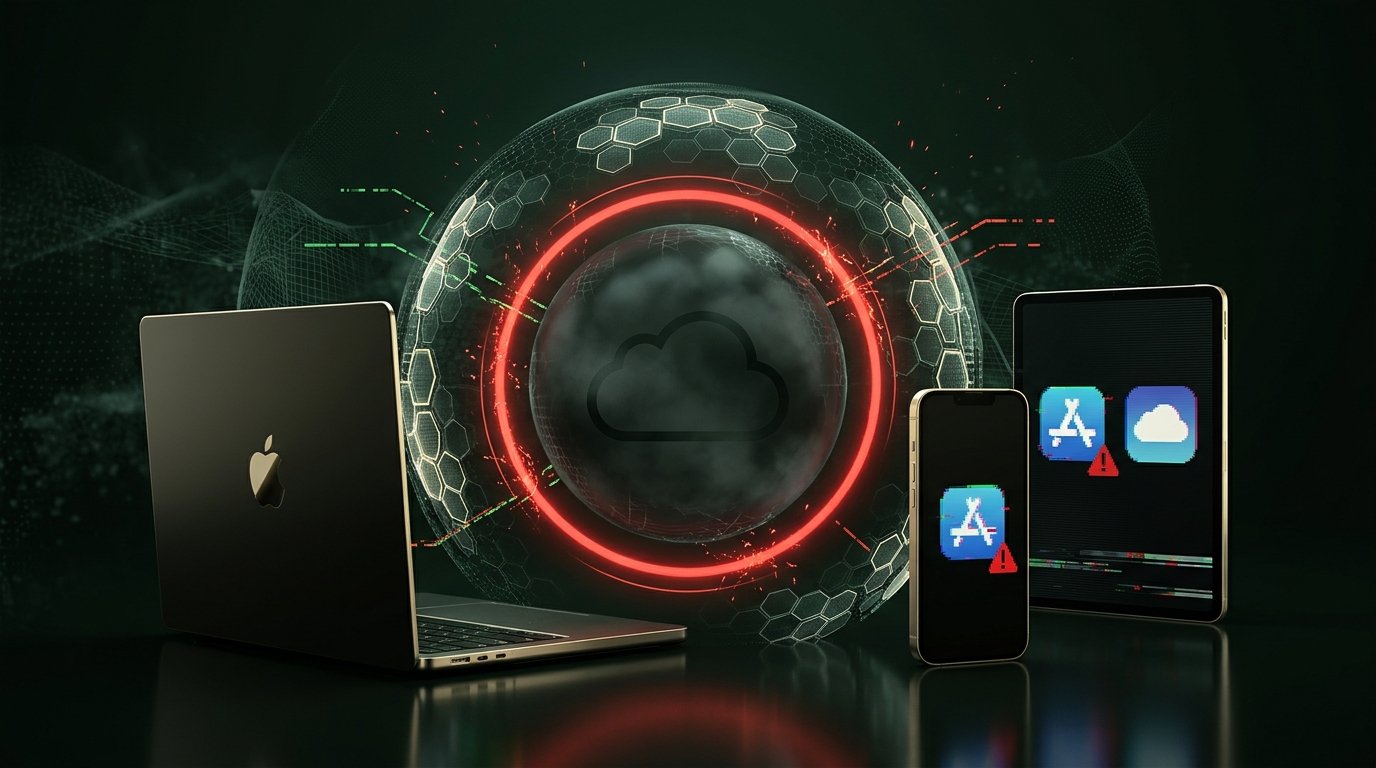
The November 17, 2026 Apple iCloud outage disrupted iCloud Account and Sign In for all users alongside the App Store, Apple Music, AppleCare, and enterprise enrollment portals for roughly six hours. Caused by an internal Apple software update rather than a cyberattack, the blackout exposed how 2.5 billion active devices rely on centralized cloud verification for everyday operation.
Six Hours That Froze a 2.5-Billion-Device Ecosystem
Consumers rarely view an iPhone or Mac as a thin client, yet Tuesday, November 17, 2026 delivered a sharp reminder of how thoroughly local silicon is tethered to Cupertino's servers. Beginning around 11:45 a.m. ET, Apple's System Status dashboard began lighting up with service failures spanning the App Store, Apple Music, AppleCare, iCloud Mail, and iCloud Web Apps. Crucially, Apple classified the "iCloud Account & Sign In" disruption as affecting all users globally before restoring full green status around 6:00 p.m. ET.
The scale of potential exposure has never been larger. Just fifteen days earlier, during Apple's November 2, 2026 fiscal fourth-quarter earnings call, CEO John Ternus reaffirmed that Apple's installed base surpassed 2.5 billion active devices worldwide—up 150 million from 2025. Sitting atop that hardware foundation is an App Store ecosystem serving over 850 million average weekly users across 175 countries and a Services division that generated $30.74 billion in the June 2026 quarter alone.
From Spontaneous Sign-Outs to Frozen Retail Counters
Unlike isolated streaming hiccups, authentication-layer failures ripple into physical commerce and device usability. During the Apple iCloud outage, users across the United States, Europe, and the UAE reported being spontaneously signed out of iPhones and Macs, only to hit verification dead ends when attempting to log back in. New iPhone buyers encountered activation errors out of the box, while Downdetector logged more than 2,300 Apple Pay incident reports and an equal spike for Apple Support—even though Apple Pay never appeared as an official outage on Apple's status page.
Enterprise Provisioning and Developer Pipeline Paralysis
The disruption cut deepest inside IT departments and software studios. Apple Business Manager, Apple School Manager, Schoolwork, and the Volume Purchase Program remained degraded even after consumer iCloud sign-in began recovering. As eBuilder Security's incident review noted, schools and enterprises relying on zero-touch mobile device management (MDM) found their onboarding pipelines stalled mid-day. Simultaneously, software developers lost access to App Store Connect, freezing binary submissions, TestFlight builds, and release approvals.
Retail Operations Hit by Shared Internal Infrastructure
The outage did not stop at customer-facing APIs. Employees at multiple U.S. Apple Store locations reported that internal point-of-sale and scheduling tools went dark, preventing staff from completing hardware purchases or booking Genius Bar appointments. That convergence illustrates how unified identity and backend orchestration link corporate retail operations directly to consumer cloud availability.
Unanswered Transparency Gaps After the Internal Update
In a brief statement provided to Bloomberg and TechCrunch, Apple attributed the Apple iCloud outage to an internal update and explicitly ruled out a cyberattack. However, Apple declined to specify which backend service changed, how many users were affected, whether any Apple Pay transactions failed, or whether the November 17 failure had any connection to a separate November 10 iCloud Mail and Calendar disruption. Notably, Apple's own fiscal 2026 annual report—covering the year ended September 26, 2026—had already warned investors that continuity and redundancy measures for its online services could prove inadequate during system upgrades.
You May Also Like
"Many of our systems are back up and running after an internal update caused some outages this morning. We're working to get the remaining systems online as soon as possible." — Apple official statement, November 17, 2026
Mapping the Blast Radius Across Apple's Ecosystem
The November 17 incident struck during an unusually volatile week for critical digital infrastructure, following Microsoft's November 12–14 SaaS disruption, a November 16 software error at JPMorgan Chase, and a November 17 internal network glitch at the National Security Agency. The table below breaks down how the Apple iCloud outage manifested across four distinct user tiers.
Stakeholder GroupDisrupted ServicesPrimary Operational ImpactRecovery PriorityEveryday ConsumersiCloud Sign-In, App Store, Apple Music, iCloud MailBlocked app downloads, failed 2FA logins, reported Apple Pay frictionRestored first (~4–5 hours)App DevelopersApp Store Connect, provisioning certificatesHalted app updates, delayed critical bug-fix releases and TestFlight buildsLagged consumer recoveryEnterprise & SchoolsApple Business Manager, Apple School Manager, VPPSuspended zero-touch MDM enrollment and bulk license assignmentExtended into evening ETApple Retail StoresInternal POS, AppleCare, appointment bookingInability to finalize in-store sales or schedule hardware repairsRestored alongside core backend
Why Cloud-Tethered Hardware Demands Local Continuity
Tight vertical integration makes Apple devices seamless when authentication tokens refresh cleanly, but it concentrates operational risk when an internal deployment misfires. IT administrators managing corporate iOS and macOS fleets should recognize several structural dependencies exposed by the Apple iCloud outage:
- Zero-touch enrollment fragility: Automated Device Enrollment (ADE) cannot bind freshly unboxed laptops or phones to corporate MDM servers when Apple Business Manager is unreachable.
- Certificate and VPP bottlenecks: Deploying urgent security patches or internal apps stalls if Volume Purchase Program token validation depends on real-time App Store Connect handshakes.
- Account-level lockout loops: Aggressive re-authentication prompts during cloud authentication errors can trigger helpdesk floods as employees assume their corporate Apple IDs were compromised.
Four Continuity Practices for Apple-Heavy Organizations
- Maintain pre-staged hot spares: Keep a small buffer of already-enrolled, MDM-verified MacBooks and iPhones on hand so new hires or executives with damaged hardware are not blocked by portal downtime.
- Cache software locally: Enable macOS Content Caching on corporate networks to serve OS updates and previously fetched App Store packages locally without hitting external Apple CDNs.
- Separate corporate identity from personal iCloud: Use federated Managed Apple Accounts backed by an independent enterprise identity provider rather than relying on consumer iCloud recovery flows.
- Establish non-Apple status alerting: Subscribe IT operations teams to independent outage telemetry alongside Apple's official System Status page, which often lags initial user reports on payment and activation services.
Frequently Asked Questions
What caused the November 17, 2026 Apple iCloud outage?
Apple confirmed that an internal software update triggered the disruption across iCloud, the App Store, and business portals, explicitly ruling out a cyberattack or external data breach.
Was Apple Pay officially affected during the November 2026 outage?
While Downdetector recorded over 2,300 user complaints regarding Apple Pay failures, Apple did not list Apple Pay on its official System Status dashboard and has not clarified whether payment processing failed.
Why did the outage disrupt schools and corporate IT teams?
Apple Business Manager, Apple School Manager, and the Volume Purchase Program experienced extended outages, preventing IT administrators from enrolling new devices into MDM platforms or distributing licensed apps.






Comments (0)
Leave a Comment