
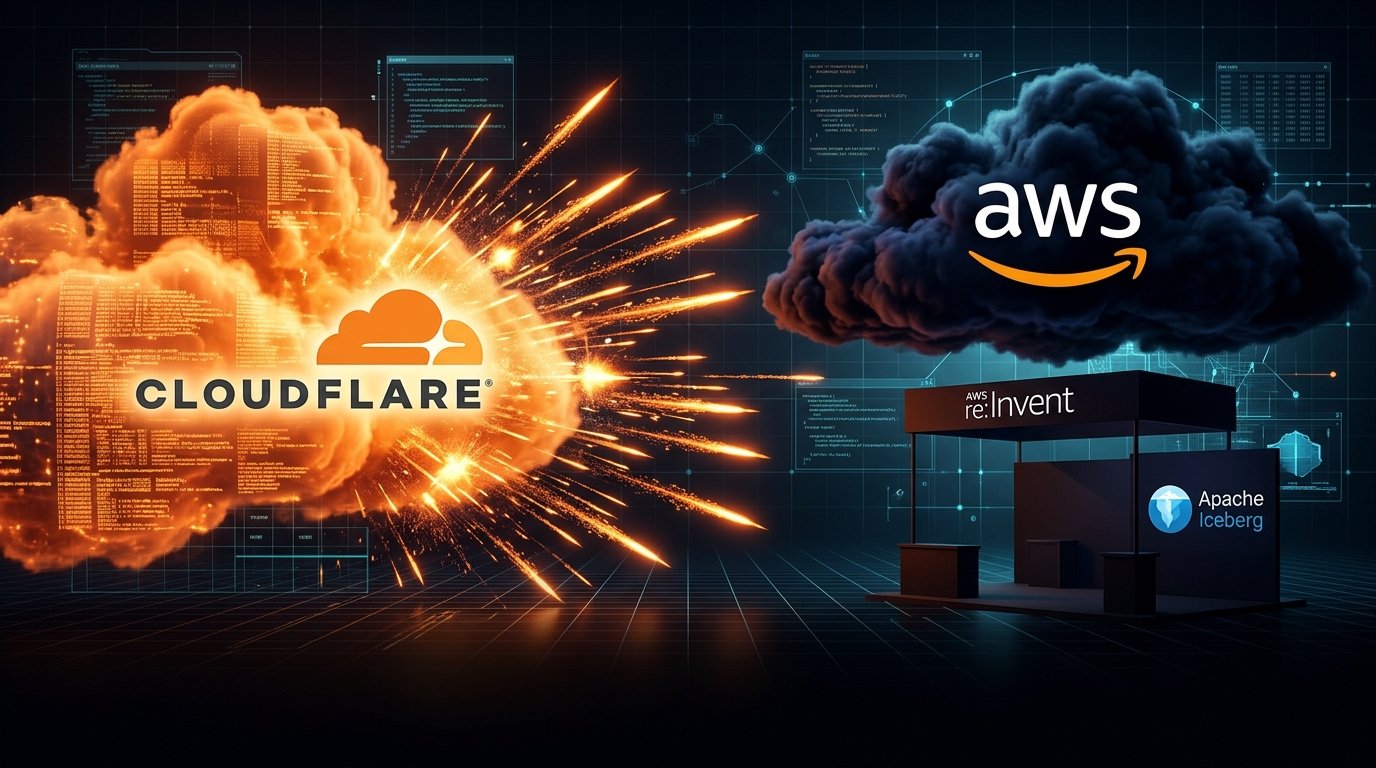
The long-simmering infrastructure rivalry between Cloudflare and Amazon Web Services (AWS) escalated into public view in October 2026. On October 17, 2026, Cloudflare CEO Matthew Prince disclosed that AWS had unilaterally canceled Cloudflare's paid sponsorship booth for AWS re:Invent 2026 (scheduled for November 30–December 4 in Las Vegas). The cancellation arrived immediately after Cloudflare's first-week-of-October Birthday Week 2026 blitz, during which the company shipped 46 separate product announcements—headlined by the October 1 general availability of Cloudflare Basin (an open data platform built on Apache Iceberg and R2), Cloudflare K2 (a durable serverless event stream), and a rebuilt Containers platform featuring persistent filesystem snapshots for AI agent sandboxes.
Why the October 2026 Cloudflare–AWS Clash Matters to Architects
As documented in Shattered.io's technical analysis of the October 2026 Cloudflare vs. AWS dispute, neither company published a formal contractual post-mortem of the booth decision, but the competitive overlap is unmistakable. Over the past decade, Cloudflare steadily expanded from a CDN and DDoS mitigation proxy into core hyperscaler revenue categories. With Birthday Week 2026, nearly every foundational AWS primitive now faces a direct, zero-egress or serverless counterpart on Cloudflare's edge network.
Infrastructure Category Cloudflare Product (Oct 2026 Status) Incumbent AWS Equivalent Core Architectural & Pricing Differentiator
Serverless Compute Cloudflare Workers (300+ cities + CPU/memory flamegraphs) AWS Lambda / Lambda@Edge City-level edge placement by default vs. regional data center provisioning
Object Storage Cloudflare R2 Amazon S3 Zero egress fees on R2 vs. per-GB outbound data transfer charges on S3
Open Data Lakehouse Cloudflare Basin (GA October 1, 2026) AWS Glue / AWS Lake Formation Built on Apache Iceberg + R2 so external query engines read data with zero egress cost
Event Streaming Cloudflare K2 (Announced Oct 2026) Amazon Kinesis / Amazon MSK (Kafka) Durable serverless event stream with zero broker or partition cluster sizing
Container Sandboxes Cloudflare Containers (Rebuilt Oct 2026) AWS Fargate / Amazon ECS Fast startup + persistent filesystem snapshots tailored for stateful AI agents
Deep Dive: Inside Cloudflare's Top October 2026 Launches
While shipping 46 updates in five days generates marketing headlines, engineering leaders evaluating cloud portability for 2027 should focus on four specific technical capabilities introduced during the first week of October 2026.
1. Cloudflare Basin: Apache Iceberg Without Warehouse Lock-In
Reaching general availability on October 1, 2026, Basin is an open data platform built atop the Apache Iceberg table format and backed by Cloudflare R2 object storage. Historically, organizations storing petabytes of analytical data in Amazon S3 faced steep egress fees whenever they queried that data from external compute engines like Snowflake, Databricks, or on-premises clusters. Because Basin pairs standard Iceberg metadata tables with R2's zero-egress pricing model, data engineering teams can ingest and compact datasets once in Basin and query them from multiple analytics engines without incurring outbound bandwidth penalties.
2. Cloudflare K2: Serverless Event Streaming Without Kafka Brokers
Operating production Apache Kafka clusters—even on managed services like Amazon MSK—requires capacity planning around broker instance sizes, partition rebalancing, and storage scaling. Cloudflare K2 introduces a durable serverless event-streaming layer designed to absorb high-throughput event ingestion and fan-out without requiring DevOps teams to provision or tune underlying clusters.
3. Rebuilt Containers with Persistent Filesystem Snapshots for AI Agents
One of the hardest infrastructure problems in late 2026 is hosting autonomous AI coding and computer-use agents. Unlike stateless HTTP microservices, an AI agent writes files, installs language packages, and mutates local repository state across multi-turn sessions. Cloudflare's October 2026 rebuild of Cloudflare Containers directly targets this workload by adding faster cold-start scheduling, flexible instance sizing, and filesystem snapshots that persist a container's working directory across separate invocations—mirroring the developer ergonomics that Vercel also targeted with Secure Compute support in Vercel Sandbox during its October 5, 2026 update.
4. FinOps Case Study: Cutting AI Inference Spend by 68%
Alongside its infrastructure launches, Cloudflare published an internal FinOps case study during Birthday Week demonstrating how it reduced the cloud inference bill for its internal AI code-review system by 68%. Crucially, the savings did not require switching foundation model vendors; instead, Cloudflare achieved the 68% cost reduction by combining aggressive prompt caching with intelligent model routing (sending routine syntax and diff checks to smaller, faster models while reserving frontier reasoning models for complex logic bugs). Alongside the launch of Clef-omni (a multimodal model supporting audio, video, images, and text) and 2x faster inference on Clef-flash, this routing pattern provides a reproducible blueprint for any engineering team battling rising LLM API bills.
Multicloud Resilience After the September 30–October 1 Azure Outage
The case for avoiding single-cloud lock-in gained further urgency during the exact same week. Microsoft disclosed that between 20:30 UTC on September 30 and 02:15 UTC on October 1, 2026, an incident disrupted management operations across six core Azure networking services: ExpressRoute Gateway, Application Gateway, Azure Firewall, Azure Bastion, Virtual WAN, and VPN Gateway. While Cloudflare cannot replace a full enterprise AWS or Azure footprint overnight, adopting zero-egress storage formats like Apache Iceberg on Basin gives enterprise buyers genuine architectural leverage during hyperscaler contract renewals.
Frequently Asked Questions
When did Cloudflare Basin reach general availability?
Cloudflare Basin went generally available on October 1, 2026 during Cloudflare's annual Birthday Week. It provides an open data platform built on Apache Iceberg and Cloudflare R2 object storage.
What is Cloudflare K2?
Announced during the first week of October 2026, Cloudflare K2 is a durable serverless event-streaming service positioned as a zero-cluster alternative to Apache Kafka, Amazon MSK, and Amazon Kinesis.
Why did AWS cancel Cloudflare's booth at re:Invent 2026?
Neither AWS nor Cloudflare published a formal contractual document, but Cloudflare CEO Matthew Prince disclosed on October 17, 2026 that AWS unilaterally canceled Cloudflare's paid sponsor slot ahead of the November 30–December 4 conference as Cloudflare expanded directly into core AWS compute, storage, and data categories.
How did Cloudflare cut its internal AI code-review inference bill by 68%?
According to Cloudflare's October 2026 Birthday Week FinOps case study, the company reduced its AI code-review inference costs by 68% by implementing prompt caching and intelligent model routing across different model tiers.



Comments (0)
Leave a Comment