
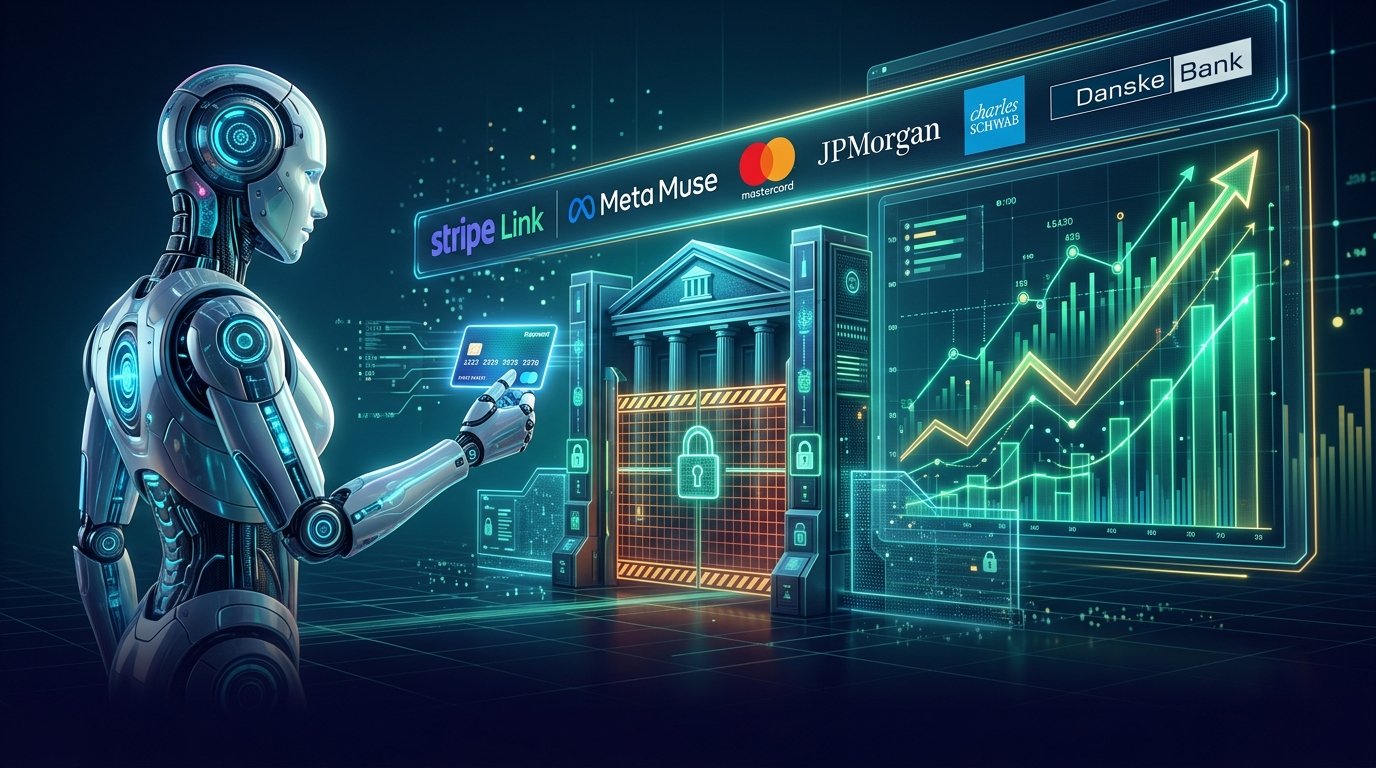
September 2026 marked the commercial inflection point for agentic AI payments—alongside the first major institutional confrontation over financial account access and fraud liability. According to data disclosed by Stripe President John Collison and analyzed by Winzheng, AI-agent-driven transaction counts through Stripe Link surged 38-fold month-over-month in September 2026, while total payment volume grew 20-fold with an average transaction size of approximately $100. In Europe, Danske Bank and Mastercard completed Denmark's first autonomous agentic AI payment via Mastercard's Agent Pay infrastructure. Yet during the exact same month, JPMorgan Chase and Charles Schwab confirmed they are actively blocking unauthorized external AI agents from accessing customer banking and brokerage accounts.
What Drove the 38-Fold Surge in Stripe Link Agent Transactions?
When Stripe and OpenAI first piloted an "instant checkout" integration across roughly a dozen Shopify merchants in September 2025, consumer adoption was negligible, and the early experiment was wound down in March 2026. The 38-fold month-over-month jump in September 2026—while growing from a small initial base and representing a fraction of Stripe's aggregate global processing volume—was driven by two converging catalysts: general-purpose computer-use models and dedicated agent payment rails.
1. Meta Muse Reaches 2.18 Million Daily Active Users
On September 8, 2026, Meta launched the consumer version of its personal AI assistant, Muse, which climbed to 2.18 million daily active users by October 5, 2026. Unlike text-only chatbots that stop at product recommendations, Muse combines GUI computer-use capabilities with direct checkout integrations through Stripe Link and Shopify Shop Pay. Retail goods ranked first in both transaction count and total payment volume across Stripe's September 2026 agentic commerce dataset.
2. Single-Use Virtual Cards and 200+ Connected AI Agents
According to Dan Hill, Stripe's head of consumer products, Stripe Link connected to roughly 200 distinct AI agents by October 2026—nearly triple the roughly 70 agents tracked in September—including Meta Muse, Instinct, Grok Bot, Skydive, and Town. To prevent autonomous agents from exposing raw consumer primary account numbers (PANs), Stripe Link issues a single-use virtual card for each authorized agent transaction across its network of roughly 300 million registered Link users on platforms such as Uber, Airbnb, and Anthropologie. This infrastructure builds on Stripe's April 2026 launch of 288 agentic commerce features and its June 2026 $7.5 billion acquisition of OpenRouter, which processes over 10 trillion tokens daily across 400+ models.
Global Agentic Payment Milestones in September 2026
The rapid buildout of agentic commerce infrastructure is occurring globally across both card networks and regional payment processors, as documented in FinTech Futures' September 2026 payments review:
- Denmark (Danske Bank & Mastercard Agent Pay): Copenhagen-based Danske Bank and Mastercard executed Denmark's first live payment completed autonomously by an AI agent. In the pilot, a consumer instructed an AI agent to book a coffee tasting experience on Priceless.com; the agent autonomously orchestrated the booking and settled the payment using a Danske Bank Mastercard via Mastercard's Agent Pay rails and partner PayOS.
- MENA Region (Egypt's Paymob $35M Pre-Series C): Cairo-founded merchant payments platform Paymob secured $35 million in pre-Series C funding in September 2026, co-led by Mubadala and the European Bank for Reconstruction and Development (EBRD). Paymob explicitly earmarked the capital to scale its MENA digital acceptance footprint and introduce new SME merchant tools tailored for agentic commerce.
Why JPMorgan Chase and Charles Schwab Are Blocking External AI Agents
While payment processors and retail merchants welcome agent-initiated checkouts, regulated depository and brokerage institutions drew a hard operational boundary in September and October 2026. Both JPMorgan Chase CEO Jamie Dimon and Charles Schwab CEO Rick Wurster confirmed that their institutions block unauthorized third-party AI agents (including Meta Muse) from logging into customer accounts or initiating fund transfers—with Schwab blocking dozens of unauthorized agent access attempts every week.
Financial Sector Layer Representative Institutions September–October 2026 Agent Policy Technical & Security Mechanism
Consumer Retail Checkout Stripe Link, Shopify Shop Pay, Mastercard Agent Pay, Paymob Actively enabling agent-initiated retail purchases (~$100 avg ticket) Single-use virtual cards, shared payment tokens, and PayOS orchestration
Brokerage & Asset Management Charles Schwab Blocks external agents from account login and trade execution Provides read-only Model Context Protocol (MCP) API only to vetted partner models; internal "Charley" assistant is informational only
Commercial & Retail Banking JPMorgan Chase Blocks third-party agents from scraping or operating customer accounts Strict anti-bot perimeter controls; restricts fund-transfer authority to authenticated human or first-party channels
The Unresolved Liability Vacuum in Agent-Authorized Commerce
The divergence between retail payment gateways and regulated banks centers on a fundamental legal question: Who pays when an autonomous AI agent hallucinates a purchase or executes an unauthorized transfer?
Federal Reserve Board Governor Christopher Waller has distinguished between "agent-assisted" workflows (where the agent gathers options and the human clicks confirm) and "agent-authorized" workflows (where the user delegates autonomous spending authority). According to a September 2026 PYMNTS Intelligence survey cited by Winzheng, 93% of merchants believe financial losses from erroneous AI-agent purchases should be paid by the AI model or agent provider—yet no major AI lab has formally accepted financial chargeback liability in its terms of service. Remember that this analysis is for financial technology education and does not constitute legal or personalized financial advice; merchants and fintech developers integrating agentic checkout must review their processor's specific dispute-resolution agreements before enabling autonomous settlement.
Frequently Asked Questions
How much did AI-agent payments grow on Stripe Link in September 2026?
According to data shared by Stripe President John Collison in October 2026, AI-agent-driven transaction counts on Stripe Link grew 38-fold month-over-month in September 2026, while total payment volume increased 20-fold with an average transaction value of roughly $100.
How does Stripe Link protect card numbers when an AI agent makes a purchase?
When a connected AI agent initiates an authorized purchase through Stripe Link, Stripe issues a single-use virtual card for that specific transaction so the AI agent never accesses or stores the consumer's real underlying credit or debit card number.
Why are Charles Schwab and JPMorgan Chase blocking external AI agents?
Both institutions block unauthorized third-party agents like Meta Muse to prevent credential harvesting, unauthorized fund transfers, and unquantified fraud liability. Instead, they limit vetted partner models to read-only interfaces based on the Model Context Protocol (MCP) and prohibit autonomous trade or wire execution.
What was Denmark's first agentic AI payment in September 2026?
In September 2026, Danske Bank and Mastercard completed Denmark's first autonomous AI-agent payment using Mastercard's Agent Pay infrastructure and PayOS to autonomously book and pay for a consumer experience on Priceless.com using a Danske Bank Mastercard.


Comments (0)
Leave a Comment