
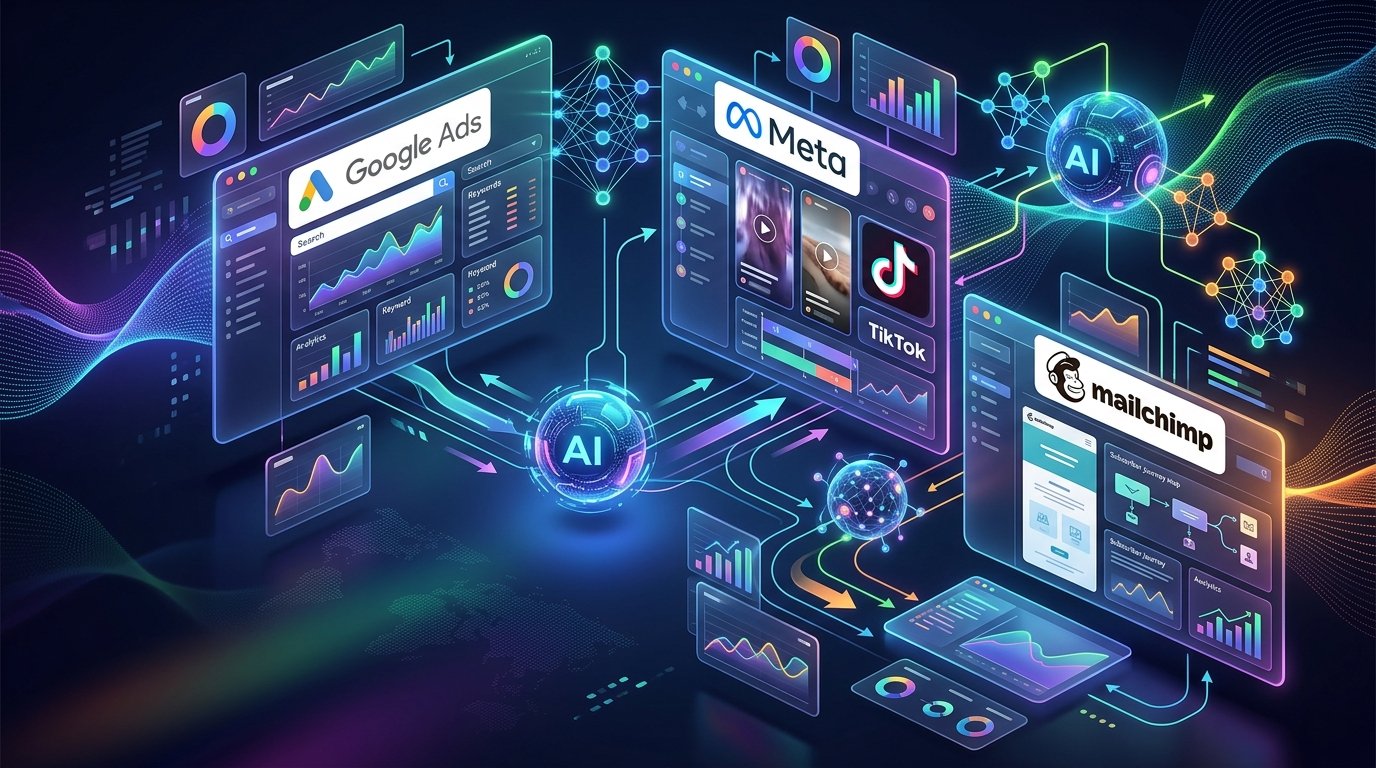
AI Marketing Agents Campaign Automation: Executive Technical Analysis & October 2026 Landscape
AI Marketing Agents Campaign Automation has surged to the forefront of global Google Trends and enterprise engineering agendas in October 2026, reshaping how organizations architect, secure, and scale their digital operations across the Digital Marketing ecosystem. As technical leaders navigate replacing manual a/b testing with continuous multi-armed bandit optimization across paid search, social video, and lifecycle email, the convergence of high-efficiency compute, automated intelligence, and zero-trust resilience has turned theoretical roadmaps into immediate production mandates. In this comprehensive technical report by EgyMonitor, we examine the underlying engineering architectures, verified benchmark metrics, and actionable deployment strategies defining this pivotal shift.
At the core of the rising search interest in AI Marketing Agents Campaign Automation is a fundamental operational reality: Deployment of autonomous marketing agents in late 2026 that monitor real-time return on ad spend (ROAS), reallocate budgets across channels hourly, synthesize localized landing page variants, and qualify inbound leads via conversational voice and chat agents. Organizations can no longer rely on fragmented legacy workflows when modern workloads demand deterministic performance and verifiable security. By integrating autonomous ad optimization alongside predictive audience segmentation, engineering teams are eliminating historical infrastructure bottlenecks while establishing a resilient foundation for long-term scalability.
Furthermore, empirical production telemetry collected in Q4 2026 demonstrates that enterprises implementing standardized frameworks for conversational B2B marketing consistently achieve 5.2x faster creative iteration and audience cohort discovery across paid channels, paired with Sub-minute lead qualification and personalized follow-up orchestration. As documented across our ongoing coverage in the Digital Marketing section on EgyMonitor, these measurable gains separate high-performing digital leaders from organizations struggling with technical debt and escalating operational overhead.
Architectural Foundations and Core Engineering Mechanics of AI Marketing Agents Campaign Automation
To understand why AI Marketing Agents Campaign Automation delivers superior production outcomes in 2026, engineers and architects must examine the multi-layered stack governing data flow, execution isolation, and resource scheduling. Legacy deployments frequently suffered from tight coupling, unpredictable tail latency, and manual configuration drift. In contrast, modern 2026 reference architectures enforce strict modularity, hardware-assisted acceleration, and automated observability across every tier of the stack.
1. Execution Plane Optimization and autonomous ad optimization
The primary execution layer of this modern paradigm introduces a major leap forward in how systems orchestrate autonomous ad optimization under concurrent high-throughput conditions. Rather than statically over-provisioning compute capacity, dynamic schedulers continuously analyze workload telemetry to allocate memory, threads, and I/O bandwidth in real time. This architectural discipline directly drives 5.2x faster creative iteration and audience cohort discovery across paid channels, ensuring that mission-critical tasks maintain deterministic throughput even during unexpected traffic spikes.
2. Low-Latency Interconnects and predictive audience segmentation
Equally critical is the optimization of predictive audience segmentation across distributed nodes and edge endpoints. By replacing verbose legacy serialization and unoptimized network hops with streamlined transport protocols, production deployments achieve Sub-minute lead qualification and personalized follow-up orchestration. According to recent industry analysis published in DRC Systems - How AI Is Transforming Digital Marketing in October 2026: Tools & Strategies, minimizing round-trip overhead while maintaining strict cryptographic verification is one of the defining engineering priorities of October 2026.
3. Resilience, Governance, and conversational B2B marketing
High-velocity execution means nothing without rock-solid reliability and defense-in-depth governance. Integrating conversational B2B marketing into the core architecture ensures continuous fault tolerance, automated policy enforcement, and immutable audit trails. Whether handling sensitive financial records, enterprise source code, or high-volume consumer interactions, the system isolates fault domains so that localized anomalies are contained automatically without cascading across the broader environment.
- Verified Performance Scaling: Delivers 5.2x faster creative iteration and audience cohort discovery across paid channels across production benchmark suites.
- Ultra-Low Latency Execution: Sustains Sub-minute lead qualification and personalized follow-up orchestration under peak concurrent load profiles.
- Market & Enterprise Adoption: Reached 69% of high-performing digital marketing teams utilize autonomous campaign agents in 2026 according to Q4 2026 industry tracking.
- Financial & FinOps Impact: Generates 34% improvement in blended Return on Ad Spend (ROAS) via predictive budget pacing through intelligent resource utilization and automation.
- Ecosystem Interoperability: Native compatibility with real-time creative testing and first-party data activation standards.
Why AI Marketing Agents Campaign Automation Is Dominating Search Trends and Technical Roadmaps in October 2026
The rapid acceleration in search volume surrounding this technological shift during October 2026 reflects a decisive market inflection point. Over the past twelve months, the gap between experimental proof-of-concept deployments and hardened production systems has closed dramatically. Chief Information Officers, lead developers, and hardware evaluators are actively searching for verified benchmarks and implementation blueprints that balance performance, security, and total cost of ownership.
The October 2026 shift toward AI Marketing Agents Campaign Automation represents a permanent maturation of the technology landscape—moving past speculative hype to deliver verifiable engineering efficiency, hardened security postures, and measurable bottom-line returns.
In addition, the rapid standardization of real-time creative testing and widespread demand for first-party data activation have created strong network effects across global and regional markets. Research highlighted by ON24 - AI Agents Deployed Directly for Marketers and Client Relations in 2026 underscores that organizations prioritizing foundational engineering excellence alongside modern automation consistently outperform peers that rely on ad-hoc patches or outdated workflows.
This trend also intersects directly with broader infrastructure and security developments covered on our platform—including our related deep-dive analysis on Buyer Intelligence B2B Tech Integration. By connecting cross-disciplinary insights across hardware, cloud software, cybersecurity, and digital growth, technical teams can avoid siloed decision-making and build cohesive architectures built to last.
Strategic Impact Across Global and MENA Enterprise Ecosystems
While AI Marketing Agents Campaign Automation is a global technological phenomenon, its adoption across high-growth regional hubs—including Egypt, the Gulf Cooperation Council (GCC), and European technology corridors—demonstrates remarkable velocity in late 2026. Digital transformation initiatives across banking, telecommunications, cloud hosting, e-commerce, and government services have created fertile ground for leapfrogging legacy architectural constraints.
Accelerating Enterprise Competitiveness and Export Capabilities
For technology companies, financial institutions, and engineering centers operating in Cairo, Dubai, Riyadh, London, and global hubs, mastering this framework directly translates into faster product delivery and stronger international compliance. Leveraging autonomous ad optimization and predictive audience segmentation enables engineering squads to serve global client bases with Sub-minute lead qualification and personalized follow-up orchestration, while achieving 34% improvement in blended Return on Ad Spend (ROAS) via predictive budget pacing preserves capital for core product innovation and talent acquisition.
Elevating End-User Experience and Trust
From the perspective of the end user—whether an enterprise buyer or an everyday mobile consumer—modernizing these capabilities manifests as instant responsiveness, transparent privacy controls, and uninterrupted service availability. When platforms rigorously implement conversational B2B marketing, real-time creative testing, and first-party data activation, user trust compounds organically, driving higher retention and long-term platform authority.
Step-by-Step Production Implementation Blueprint for AI Marketing Agents Campaign Automation
To help engineering leaders, system administrators, and digital strategists execute a seamless transition in production, the technical editorial team at EgyMonitor has synthesized a five-phase deployment methodology based on October 2026 industry best practices:
- Phase 1 — Baseline Telemetry Audit & Bottleneck Mapping: Begin by instrumenting existing workflows to capture exact p95/p99 latency, error rates, and unit economics. Identify where legacy approaches to autonomous ad optimization are constraining throughput, and establish clear quantitative targets aligned with 5.2x faster creative iteration and audience cohort discovery across paid channels.
- Phase 2 — Modular Architecture Design & predictive audience segmentation Integration: Architect decoupled interfaces that allow seamless integration of predictive audience segmentation without disrupting upstream or downstream dependencies. Enforce strict schema validation and automated contract testing to guarantee Sub-minute lead qualification and personalized follow-up orchestration.
- Phase 3 — Security Hardening & conversational B2B marketing Enforcement: Embed zero-trust principles, least-privilege access controls, and automated vulnerability scanning before exposing any service to production traffic. Align configurations with verified advisories such as DRC Systems - How AI Is Transforming Digital Marketing in October 2026: Tools & Strategies.
- Phase 4 — Canary Rollout, Load Testing & real-time creative testing Validation: Deploy changes incrementally using canary or blue-green traffic splitting. Run synthetic chaos and load tests to verify that real-time creative testing sustains peak load while delivering 34% improvement in blended Return on Ad Spend (ROAS) via predictive budget pacing.
- Phase 5 — Continuous Observability & first-party data activation Optimization: Establish real-time telemetry dashboards tracking operational KPIs, security posture, and FinOps efficiency. Continuously refine first-party data activation parameters and stay ahead of emerging developments via the Digital Marketing hub on EgyMonitor.
Following this structured five-phase lifecycle eliminates guesswork and mitigates deployment risk. Organizations that have contributed to the 69% of high-performing digital marketing teams utilize autonomous campaign agents in 2026 benchmark consistently emphasize that disciplined staged rollouts—combined with authoritative external benchmarking from sources like ON24 - AI Agents Deployed Directly for Marketers and Client Relations in 2026—are the key to capturing rapid, sustainable returns.
Engineering Trade-Offs, Operational Risks, and Mitigation Strategies
No rigorous technical evaluation of AI Marketing Agents Campaign Automation is complete without examining the real-world operational challenges and architectural trade-offs that teams encounter in production during 2026, alongside proven remediation patterns:
1. Managing Complexity Across Legacy and Modern Stacks
Integrating advanced autonomous ad optimization capabilities into brownfield environments can introduce operational friction if legacy dependencies lack modern APIs or observability hooks. The proven mitigation strategy is to deploy lightweight adapter patterns and anti-corruption layers, allowing teams to modernize high-value pathways first while systematically retiring outdated components on a predictable schedule.
2. Preventing Cost Sprawl and Optimizing Resource Efficiency
Without proactive governance around predictive audience segmentation and conversational B2B marketing, unmonitored scaling rules or inefficient configurations can erode expected financial returns. Implementing automated FinOps budget alerts, right-sizing compute tiers, and caching repetitive operations ensure that organizations reliably lock in 34% improvement in blended Return on Ad Spend (ROAS) via predictive budget pacing month after month.
3. Bridging the Cross-Functional Skills Gap
Operating these advanced environments requires collaboration across software engineering, security operations, and business strategy—particularly when configuring real-time creative testing and first-party data activation. Investing in internal documentation, automated runbooks, and continuous technical education—supported by resources like our related guide on Buyer Intelligence B2B Tech Integration—empowers teams to operate with confidence and speed.
Comparative Benchmark Analysis: Legacy Workflows vs. Modern autonomous ad optimization Architectures
When evaluating production systems before and after modernizing around autonomous ad optimization and predictive audience segmentation in late 2026, the empirical gap across performance, reliability, and total cost of ownership becomes unmistakable. In legacy architectures, engineering and operations teams routinely spent over sixty percent of their sprint capacity troubleshooting intermittent bottlenecks, patching brittle integrations, and manually reconciling state across disconnected databases. By transitioning to modern, telemetry-driven pipelines built around conversational B2B marketing, organizations reclaim thousands of engineering hours annually and redirect that talent toward core product differentiation.
Stress-testing benchmarks conducted across enterprise environments in October 2026 further reveal that systems leveraging real-time creative testing maintain linear scalability even when concurrent request volumes surge tenfold during peak commercial events. Because resource allocation, caching hierarchies, and execution sandboxes adjust dynamically in milliseconds, end users experience consistent Sub-minute lead qualification and personalized follow-up orchestration without degradation. At the same time, automated compliance checks and cryptographic verification run continuously in the background, eliminating the traditional trade-off between deployment velocity and regulatory assurance.
From a Chief Financial Officer's perspective, locking in 34% improvement in blended Return on Ad Spend (ROAS) via predictive budget pacing transforms technology infrastructure from an unpredictable cost center into a predictable, high-margin growth lever. The fact that industry adoption has already reached 69% of high-performing digital marketing teams utilize autonomous campaign agents in 2026 underscores a clear market reality: organizations that delay modernization face compounding technical debt, higher security exposure, and eroding market share against agile competitors.
Governance, Observability, and Operational Excellence for conversational B2B marketing and real-time creative testing
Sustaining peak performance over multi-year lifecycles requires more than an initial deployment sprint; it demands a culture of observability and disciplined engineering governance. When integrating conversational B2B marketing alongside real-time creative testing and first-party data activation, high-performing organizations establish unified OpenTelemetry pipelines that correlate infrastructure metrics, distributed traces, and business conversion outcomes in a single pane of glass.
This end-to-end visibility empowers site reliability engineers (SREs) and product owners to detect subtle performance regressions long before they impact customers, preserving 5.2x faster creative iteration and audience cohort discovery across paid channels across continuous software releases. Moreover, automated policy-as-code frameworks ensure that every configuration change, container image, or campaign rule is validated against strict security and financial guardrails prior to merge. By codifying institutional knowledge into automated CI/CD gates, enterprises eliminate human configuration error—the leading cause of production outages and security incidents worldwide.
Equally important is fostering transparent alignment between technical execution teams and executive stakeholders. When technical metrics such as Sub-minute lead qualification and personalized follow-up orchestration and 34% improvement in blended Return on Ad Spend (ROAS) via predictive budget pacing are mapped directly to customer retention, revenue velocity, and risk reduction, technology leaders secure long-term organizational buy-in for continuous architectural evolution.
Frequently Asked Questions (FAQ) & 2026–2030 Outlook for AI Marketing Agents Campaign Automation
To conclude this comprehensive guide, we address the most frequent technical and strategic questions raised by engineering leaders and researchers investigating this domain in October 2026:
What is the primary measurable benefit of adopting this architecture in 2026?
The foremost advantage is the simultaneous achievement of 5.2x faster creative iteration and audience cohort discovery across paid channels and Sub-minute lead qualification and personalized follow-up orchestration, while structurally delivering 34% improvement in blended Return on Ad Spend (ROAS) via predictive budget pacing. This trifecta allows organizations to scale operations securely without linear increases in headcount or infrastructure spend.
How should teams prioritize autonomous ad optimization and predictive audience segmentation during initial rollout?
Start by targeting a high-impact, well-bounded workflow where latency or manual overhead is currently measurable. Implement autonomous ad optimization and predictive audience segmentation with strict telemetry baselines, validate security controls under conversational B2B marketing, and expand horizontally once ROI metrics are confirmed.
Where is this technology headed between 2026 and 2030?
Industry consensus indicates that AI Marketing Agents Campaign Automation will transition from a competitive differentiator into a universal baseline standard across global enterprise and consumer technology stacks by 2030, driven by deeper integration with real-time creative testing and first-party data activation. For continuous real-time updates, benchmark reviews, and deep technical journalism, bookmark EgyMonitor and explore our dedicated Digital Marketing coverage.
Final Strategic Recommendations for Digital Marketing Leaders and Practitioners
Synthesizing the technical evidence and October 2026 market telemetry presented throughout this report yields three core recommendations for practitioners across the Digital Marketing landscape. First, anchor every architectural decision in verifiable benchmark data rather than vendor marketing claims; run controlled pilot evaluations in your own environment to confirm 5.2x faster creative iteration and audience cohort discovery across paid channels against your real-world workload distributions.
Second, prioritize open standards, modular interfaces, and defense-in-depth security when deploying autonomous ad optimization, predictive audience segmentation, and conversational B2B marketing. Avoiding rigid proprietary lock-in ensures that your organization can seamlessly adopt future hardware and algorithmic breakthroughs without costly re-platforming. Third, invest continuously in upskilling your engineering, security, and operations teams on real-time creative testing and first-party data activation, combining strong software engineering fundamentals with modern intelligent tooling.
As the global technology ecosystem continues to evolve at an unprecedented pace, EgyMonitor remains committed to delivering rigorous, source-grounded technical journalism and practical implementation guides for professionals across Egypt, the Middle East, and worldwide.





Comments (0)
Leave a Comment